



When it comes to franchise investments, smart investors know that it’s not just about how much money a business makes—it’s about how efficiently that business turns your initial investment into revenue. And that’s exactly why The Swing Bays indoor golf and fitness franchise is turning heads in the franchise investment community.
Understanding Sales to Investment Ratios
Let’s talk about why the sales to investment ratio matters so much. Think of this metric as your franchise’s efficiency score. It tells you how many dollars in annual sales you’re potentially generating for every dollar you invest upfront.
A ratio of 1.0 means you’re generating $1 in annual sales for every $1 invested. A ratio of 2.0? You’re generating $2 in sales for every dollar invested. The higher the ratio, the more efficiently your investment is working for you. This matters tremendously because it directly impacts how quickly you can recover your initial investment and start seeing real profits.
The Swing Bays Is A Standout Performer
Let’s look at what makes The Swing Bays so compelling for investors:
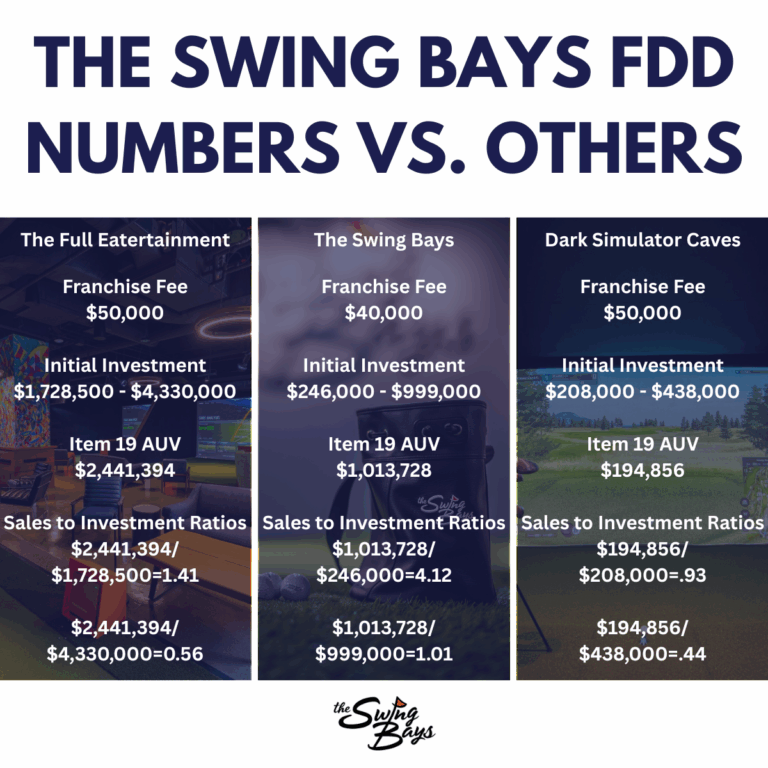
The Swing Bays Franchise Numbers*:
- Franchise Fee: $40,000
- Initial Investment Range: $246,000 – $999,000
- Item 19 Average Unit Volume (AUV): $1,013,728
Sales to Investment Ratios:
- Low-end investment: $1,013,728 ÷ $246,000 = 4.12
- High-end investment: $1,013,728 ÷ $999,000 = 1.01
That 4.12 ratio on the low-end investment is exceptional. It means that for every dollar you invest, you’re generating over four dollars in annual sales. Even at the high-end investment scenario, you’re still potentially achieving a 1:1 ratio, which is solid performance.
How Does The Swing Bays Stack Up Against Competitors?
To truly appreciate these numbers, let’s compare them to other popular entertainment and simulation franchise concepts.
The Full-Service Entertainment Franchise
This competitor focuses on entertainment with a full food and beverage buildout:
- Franchise Fee: $50,000
- Initial Investment: $1,728,500 – $4,330,000
- Item 19 AUV: $2,441,394
Sales to Investment Ratios:
- Low-end: $2,441,394 ÷ $1,728,500 = 1.41
- High-end: $2,441,394 ÷ $4,330,000 = 0.56
While this franchise generates higher revenue ($2.4 million versus $1 million), the investment required is substantially higher. The low-end ratio of 1.41 is respectable, but it’s less than half of The Swing Bays’ 4.12 ratio. Even more concerning, the high-end ratio drops to 0.56—meaning you’re generating only 56 cents in annual sales for every dollar invested. That’s a much longer path to profitability.
The Simulator Cave Franchise
This golf simulator concept offers a lower entry point:
- Franchise Fee: $50,000
- Initial Investment: $208,000 – $438,000
- Item 19 AUV: $194,856
Sales to Investment Ratios:
- Low-end: $194,856 ÷ $208,000 = 0.93
- High-end: $194,856 ÷ $438,000 = 0.44
While the initial investment is lower, the sales volume doesn’t justify even that reduced investment. With ratios below 1.0, you’re not even generating a dollar in annual sales for every dollar invested. This means a significantly longer breakeven timeline and lower overall return potential.
The Swing Bays Wins on Efficiency
The Swing Bays achieves something rare in the franchise world: strong revenue generation potential with a manageable initial investment, particularly at the lower end of their investment range. This creates several advantages for investors:
Faster Potential Path to Profitability: With a 4.12 sales to investment ratio, franchisees can potentially recover their initial investment much faster than competitors. Less capital tied up for shorter periods means better overall returns.
Lower Risk Entry Point: The ability to start at $246,000 (compared to $1.7 million+ for the entertainment competitor) means you can test the concept without betting the farm. This lower barrier to entry also means you might be able to open multiple locations sooner, accelerating your wealth-building potential.
Operational Simplicity: The numbers suggest The Swing Bays has found a sweet spot—generating impressive revenue without the complexity and overhead of full-service food operations. Less complexity often means easier operations, lower labor costs, and better margins.
Scalability: Strong unit economics at lower investment levels make it more feasible to become a multi-unit operator, which is where many franchisees build real wealth.
Other Key Franchise Investment Considerations
While sales to investment ratios are crucial, savvy investors know they’re just one piece of the puzzle. Before signing any franchise agreement, also consider these factors: the franchisor’s support system (training, marketing, and ongoing operational support can make or break your success), the strength of the brand and market demand in your target territory, realistic operating costs and profit margins beyond just top-line revenue, your own skills and interests (passion for the business matters), the franchise agreement terms including territory rights and renewal options, and the existing franchisee satisfaction levels (talk to current owners about their experiences). The best franchise investment is one where strong numbers meet strong support, a proven system, and your personal goals.
The Bottom Line
The Swing Bays indoor golf and fitness franchise stands out in a crowded franchise market by delivering something investors crave: efficiency. With a sales to investment ratio that more than triples its closest competitor at the low-end investment level, The Swing Bays offers a compelling value proposition for entrepreneurs looking to enter the booming indoor golf and fitness industry.
While no investment is without risk, and past performance doesn’t guarantee future results, the Item 19 numbers tell a clear story: The Swing Bays has cracked the code on generating strong revenue without requiring franchise owners to make a massive capital commitment. For investors who want to maximize their return potential while minimizing their risk exposure, that’s exactly the kind of opportunity worth exploring.
Ready to swing into your next investment? The numbers suggest The Swing Bays might just be the franchise opportunity you’ve been looking for. Connect with someone and see the full FDD here.
*These figures can be found in Item 19 of the 2025 FDD issued by The Swing Bays Franchise, LLC.“Gross Revenue” includes all revenues generated from the Affiliate-Owned Location. Gross Revenue does not include the amount of any applicable sales tax imposed by any governmental authority. Also excluded from Gross Revenue is the amount of any documented refunds, returns, and discounts given to customers, as well as tips collected by employees. Gross Revenue includes a 30% split of the revenue generated by instructors in connection with the lessons they provide to customers since the Affiliate-Owned Location receives 30% of the revenue generated by those lessons.Written substantiation for the financial performance representation will be made available to the prospective franchisee upon reasonable request.This information is not intended as an offer to sell or the solicitation of an offer to buy a franchise. It is for informational purposes only. The offer of a franchise can be made only by a franchise disclosure document. Currently, the following states regulate the offer and sale of franchises: California, Hawaii, Illinois, Indiana, Maryland, Michigan, Minnesota, New York, North Dakota, Oregon, Rhode Island, South Dakota, Virginia, Washington, and Wisconsin. If you are a resident of or want to locate a franchise in one of these states, we will not offer you a franchise unless and until we have complied with applicable pre-sale registration and disclosure requirements in your state.