
For decades, traditional retail has been a go-to path for entrepreneurs and franchise operators looking to build strong businesses. Large storefronts, high staffing needs, and heavy reliance on foot traffic were simply part of the equation. It’s a model that has worked, but one that is increasingly being questioned by experienced operators who understand just how complex, costly, and difficult to scale it can be.
Today, a growing number of operators are stepping back and considering- Is there a more efficient way to scale? That’s exactly the question seasoned entrepreneur Jay Jones asked during his search for his next business venture.
The Problem with Traditional Retail Models
Traditional retail franchises were built for a different era. While they can still succeed, they often come with structural challenges that make scaling difficult:
- High labor requirements, often 10–50+ employees per location
- Large, expensive buildouts and long development timelines
- Heavy dependence on foot traffic and location performance
- Manual systems that introduce inefficiencies and inconsistency
For operators looking to grow beyond one or two locations, these challenges can multiply and turn expansion into a complex and capital-intensive process.
An Operator Who Chose a Different Path
Jones knows the traditional model well. Raised in an entrepreneurial family, he grew up working in his father’s janitorial business, eventually becoming general manager at just 19 years old. After attending a University, Jones went on to pursue his first franchise opportunity in the restoration industry. He built his career through hands-on ownership, eventually scaling and exiting the franchise before spending over a decade in the insurance industry.
When he decided to return to business ownership, he did what any experienced operator would do: he explored his options. Jones evaluated a wide range of opportunities, including traditional retail and quick-service restaurant concepts- before ultimately choosing PayMore.
“I’ve always had the drive to build something,” said Jones. “After years in service-based businesses and insurance, I was ready for something dynamic again- something with real growth potential.”
What Made PayMore Different
The difference wasn’t just the category, it was the structure of the business itself. PayMore specializes in buying, selling, and trading pre-owned electronics, offering customers instant cash for their devices while promoting sustainability through reuse and recycling. The brand has gained traction nationwide by combining a modern retail experience with strong consumer demand in the secondary electronics market.
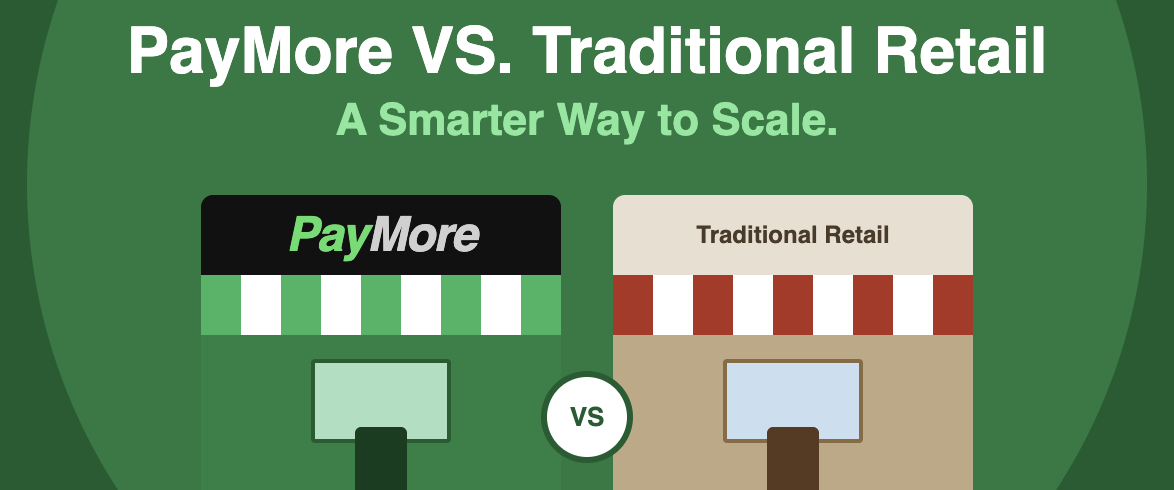
Unlike traditional retail concepts, PayMore is built around simplicity and efficiency:
- Just 2–4 employees per store
- A ~500–1,200 sq ft footprint
- Tech-enabled pricing and operations
- Majority of revenue is driven online
- A repeatable model designed for multi-unit growth
For Jones, the decision ultimately came down to fundamentals: demand, simplicity, and control. “Electronics aren’t going anywhere,” he said. “There’s always a new version coming out, which means there’s always supply and demand. When you combine that with sustainability and a business model that’s efficient and scalable, it just makes sense.”
Compared to his previous experience in restoration, where revenue was heavily tied to insurance contracts, PayMore offered something different: predictability and control. “In restoration, you’re often at the mercy of insurance companies,” Jones said. “With PayMore, you have more control over your business, your margins, and your growth.”
One of the biggest differences between traditional retail and newer models like PayMore is how they scale. Traditional retail often requires adding more of everything; more employees, more space, more complexity with each new unit. PayMore takes the opposite approach- streamlining operations so that expansion becomes more efficient, not more complicated. That distinction has fueled the brand’s rapid growth, with over 100 stores open and over 500 more in development across multiple countries.
A New Era of Retail
Jay Jones’ story isn’t an outlier, it represents the broader shift we’re seeing in franchising. Across the industry, experienced franchisees are moving away from models that rely on heavy labor, large footprints, and operational complexity. In their place, they’re choosing concepts that are leaner, more systemized, built for modern consumer behavior and designed to scale efficiently. PayMore represents that shift.
The next generation of franchise growth won’t be driven by bigger footprints or larger teams- it will be driven by smarter systems, and operators like Jay Jones are ahead of the curve. Operators aren’t just looking for businesses that work, they’re looking for businesses that can grow efficiently, predictably, and without unnecessary complexity. And for the hundreds of operators that are standing with PayMore, that future is already in motion.