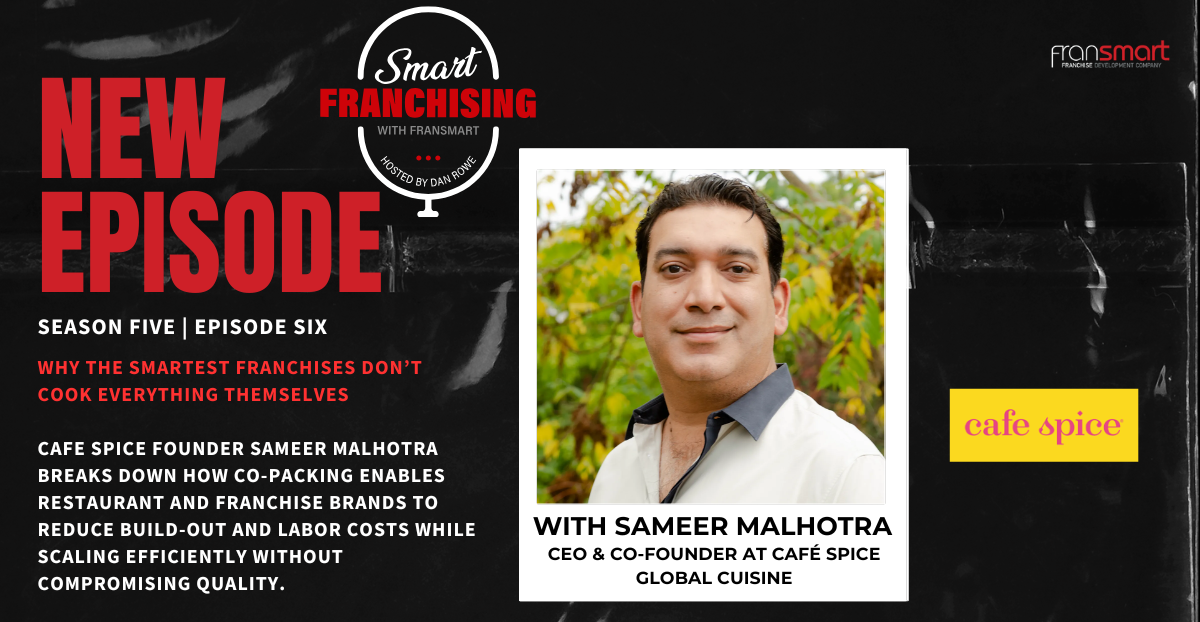
Dan Rowe (00:01)
All right, welcome back to Smart Franchising with FramSmart, and I can think of no smarter franchising.
than to focus on co-packing to drive ROI, lower opening costs, lowering the number of employee and labor hours, simplifying operations, enhancing food safety, reducing cleaning, et cetera, et cetera, et cetera. And today we’re joined by my good friend, Samir Malhotra of Cafe Spice, New Jersey, who specializes in Indian co-packing. But you guys do more than that too, right? You guys are also doing Latin, Asian, et cetera.
Sameer Malhotra (00:35)
Yeah, we’re doing all different types of cuisines and focus on sauces, grains, ready meals. I mean, we do a bunch of business for Whole Foods Market, other supermarket chains around the country. you know, originally, you know, we met us years ago, we started as a restaurant chain and the goal was to standardize our recipes. We went in a little bit of different direction, but ⁓ now with our new facility, we’re working with not only retailers, food service providers to…
Kind of just standardized recipes more than anything else.
Dan Rowe (01:07)
Well, cool. Well, thanks for doing this. And I appreciate, mean, I appreciate you giving us some of the, some of your background, like how about if we hear your story, how the whole company started? Cause it didn’t start as a co-packer. It started off. remember seeing you guys, I think you guys were in whole foods or something. And I saw the logo item and I cold called you guys to see if I could create a chain out of it. And you already had a couple of stores, but no interest in the chain. You guys went in a different direction, but how about if you just start from the beginning? How about some of your family’s
story.
Sameer Malhotra (01:38)
Yeah, mean, yeah, so my father, you know, we were brought up in the fine dining business. My father had the number one Indian restaurant in New York called Dawat on 58th Street. And, and we basically started a bistro chain called Cafe Spice, which started down by NYU in 1998. I was at Babson College at the time. And the goal was to expand these
restaurants and with the hub and spoke model really, right? We opened Cafe Spice as a bistro, but then we also opened Cafe Spice Express, which was in Grand Central Station, the first one. New York went through this whole renaissance of Grand Central Station where you wouldn’t want to walk into Grand Central. And then after the year 2000, they revitalized it with all of this, the food hall, what they called it, the dining concourse, that’s what they called it.
And they went to the top restaurateurs in New York to put concepts together for there. And my father was one of them. So we put Cafe Spice Express in Grand Central. And ⁓ while I was at Babson, I did a business plan around expanding these restaurants and express outlets through a commissary model, really. And we opened a 5,000 square foot commissary in Long Island City in Queens, had our own trucks, and we were standardizing the recipes, sauces.
ready meals, like all that kind of stuff, to about eight restaurants. We opened one in Jersey City. And I think you actually saw us and we had one in Roosevelt Field Mall in Long Island. so we had expanded to a bunch of them all being fed out of this commissary in Queens. ⁓
Dan Rowe (03:22)
But without
a commissary, I explain to people how complicated Indian food is to make.
Sameer Malhotra (03:27)
Now, Indian food is, the reason this worked is Indian food, making it from scratch is not easy. First of all, you need to grind your spices, the auto sourcing of different, different spices, ⁓ the timing of how long they’re cooked and things like that. And ⁓ in addition, to get the skilled labor that’s required for parts of it is tough too. You need to have certain visas and things like
So it wasn’t easy for my dad to expand past five or six restaurants. know, he had the pedigree, so he was able to do it. But if you want to really scale, it wasn’t really possible without having someone else. And so the kind of goes to the Whole Foods story, right? The Whole Foods was trying to make their Indian food from scratch. They put it, they opened this probably their highest volume store in Columbus Circle in New York, and they put in the New York Times they’re going to serve Indian food every day. Now,
That’s something we’ve seen in the UK where Indian food is selling in supermarkets, but it wasn’t something we had seen here. And this was 2002. My father and I walked into the store, saw that they’re struggling, right? It’s lunchtime in New York City and a new store, they’re not able to do it. Trying to make it from scratch, using all those spices, using all those sauces and not having the skilled labor that I spoke about earlier. So within minutes, they’d be saying, we have a location at Grand Central. We have a commissary that makes all of our products there.
And within the next day, they were overlooking at our facility. And then two days later, they were buying all their Indian food for us from that one store. And now we supply the Indian food to all their stores nationwide. ⁓ It’s pretty cool, but that’s where it is, right? The skilled labor is not there. All the ingredient sourcing not there. So that’s why our concept works for these type of retailers. It works for corporate cafeterias. Like we work with Aramarks, Sodexo, those type of companies where they have
a little bit of a culinary skillset, but they don’t have the Indian culinary skillset. And they need to put out Indian food or they need to put out other food. Our cafe spice, which we concept works for that. Same way now is restaurants ⁓ quick service. We were maybe a little bit early in 2002, 2003, we still kind of needed that skill labor. fast forward to now, Indian food is really just on the horizon, like just going up.
And a concept like us works for that, making sauces. We work with a couple of different quick service chains and then Indian food works for them.
Dan Rowe (06:02)
And so without naming names, the chains, so you provide them what? Cause like if I go to a place and it’s in an Indian place and I want chicken tikka or, or, you know, butter chicken or whatever it is, I just want it to taste like I think it’s supposed to taste and you make it easy. How
Sameer Malhotra (06:20)
So it could work like for larger chains, we can do their custom recipes for them, where they have a particular tikka masala sauce they want, like a makhani sauce, we can make that. They want a particular saag as a spinach. Grains are very difficult to get consistent, so we may make their grains for them, whether it be a biryani or be their lemon rice, and then marinades if needed too. So sometimes you will still want those grilled meats, which need to be made fresh, but we will help.
standardize the marinades for them and make those marinades.
Dan Rowe (06:53)
And for a restaurant though, you think about, know, when I think I started off washing dishes and I was a short order cook, like the worst jobs, the worst jobs in the restaurant are prep and cleaning. And so working with you, like if you guys are bringing in sauces or bringing in certain items, like especially if you guys can do some of the side items, like that’s a lot of prep and a lot of cleaning that that restaurant no longer has to do, right?
Sameer Malhotra (07:19)
It’s prep, cleaning, and again, another part of it is real estate, right? When you’re trying to expand a chain and you need to give certain amount of your space in your restaurant to this prep and cleaning. If you can take a couple hundred square feet off on replicating this when you’re looking to expand to 100, to 1,000, that’s a lot of money. So if you’re able to work with a co-packer or commissary that can do…
all that work and you can remove that out of the real estate you need. You can look at a much smaller format store when you’re expanding, which is a lot less rent, especially when you’re looking in cities. And it helps out a lot too.
Dan Rowe (07:57)
What are some of the other benefits of co-packing people aren’t thinking about?
Sameer Malhotra (08:02)
Consistency, what we’re talking about, labor savings, ⁓ the real estate costs, which I just mentioned, and just overall scale to grow, right? You’re very hesitant to grow. If you don’t have a good product, people aren’t going to come back, right? People might come for the social media, they may come for this, but if they don’t love the taste, they’re not coming back. So the consistency is important there. And for the customers we have, track the data. A lot of people are tracking data now. They see that the items that are consistent are what people are coming
The specials, LTOs will always be needed, but the items that they’re coming back for is that core menu. And if you have rice that’s tasting a little al dente one day, ⁓ you’re not gonna come back as often unless you’re getting a consistent product, especially in QSRs or franchise.
Dan Rowe (08:49)
Yeah, what about food safety?
Sameer Malhotra (08:52)
So we have, so this is funny being restaurateurs though. That’s the one place we didn’t think about when we were opening our commissary and that thing. So my entire facility is built out of like, my team is all quality control conscious because as restaurateurs are making product that’s going to be served right away. Right. And with working with. Commissaries like us, our products are going to be maybe six months down the line, depending if it’s frozen or 30 days online, those sauces are going to be consumed.
So we build the whole thing on quality control, USDA. ⁓ There’s FDA, USDA bodies governing everything we make, looking at the temperatures, looking at the sanitation that we use. So you know that the product you’re getting from us is clean and that’s really hard to maintain in a restaurant setting.
Dan Rowe (09:40)
Yeah. And then you guys make it, how hard is it to get it delivered to a store? You guys go through broadliners or do they have to have you guys FedExing stuff to them?
Sameer Malhotra (09:49)
No, we’re not FedExing. It’s working through broadliners. It’s working through, but sometimes smaller chains might work with a smaller distributor who they have a deal with for the other products they buy and they ask them to stock our items for them. We may deliver to them. all depends. But yeah, we supply nationally. So we work with a lot of the broadliners, but usually the supermarket chain will be able to dictate who, sorry, not the supermarket, the restaurant chain will be able to dictate who they work.
Dan Rowe (10:17)
Yeah. So whatever any of the big broadliners you guys can work through. That’s great. When I think about, you know, and it’s not quite this easy, but the difference between Indian food, Middle Eastern food, Latin food, Asian food, a lot of times, I mean, they use the same veggies, the same meats. What’s different about them is the seasonings and the spices, right. And the cooking techniques. So you guys don’t just make Indian foods. How, how will you guys transition? How do you guys transition into?
⁓ like Latin for example, or even Asian.
Sameer Malhotra (10:50)
So yeah, our team is culinary trained, right? We may have started as an Indian company, but we make great high quality food. So that’s what translates to the restaurant market, supermarket market. although the spices and seasonings are, I think that we are launching a new item with the chicken mole. And I think our mole is as good as any other mole that I’ve ever tasted. ⁓ So.
the same flavor, if you’re culinary driven, we can replicate it. And the fact that we are culinary driven when it comes to our chef at the top and our culinary director on the top and below, I think that’s what translates to it. You’re not just looking at, you may be an Indian company, or Indian owned company, but we are able to make anything possible.
Dan Rowe (11:37)
Yeah. And I remember when I was launching five guys way back in the day, we could only sell territories. Like everything at five guys, you could get off the U S food truck except for the bread. So we could only grow wherever we could get, um, the bread made, right? Like, so we had this source, uh, bread co-packers when I was growing the whole all guys, the whole all guys said, you can only start franchising once you co-pack our sauces or white sauce or red sauce.
Sameer Malhotra (11:48)
Mm-hmm.
Dan Rowe (12:04)
the rice seasoning mix. so it’s like, yeah, that turned out to be a good one.
Sameer Malhotra (12:06)
I wish I had my plant at that time.
Dan Rowe (12:12)
But think about it like, it was funny because they had carts when I met Hello Guys, they just had carts and you know, they use chicken, they use meat, they use gyros, so does everyone else. What was different about it was their seasonings and their sauces. and, and ⁓ they said, you know, like our white sauce and our red sauce, that stuff’s like fire. And they’re like, you know, that’s our, that’s basically the franchise. We don’t want a franchise unless you can figure out how to co-pack that and get it that way in every store. And from the beginning, from the very beginning,
We found a co-packer when they only had carts who would not only supply all the U S stores, but also the international stores. Like they sold to Asia, the UK, all across Canada. So sourcing a co-packer was super, super important for us. But you think about, mean, not only all the things that you mentioned about food safety and cleaning and all that other stuff was like, you got to protect the brand, right? You got to protect the brand. So who, who makes a good, who’s a good client for you? Because like,
I know when I first was calling people for Halal Guys, for example, they’re like, well, we could be interested, how much are you ordering? How big are you? And the answer wasn’t great, we just had three cards. And so I had to get someone who believed that we would actually turn that into a chain. Otherwise, people don’t probably realize how hard it is for you to make a custom something for somebody if they’ve only got one store.
Sameer Malhotra (13:37)
Yeah, well, am, well, so a couple of things. I just got to touch on that. Who, what size would make, so we have two facilities. That’s why we had a previous facility and then we knew one which is much larger batch. So, and we’re very entrepreneurial. So we were willing to work with the smaller chain as they get ready for the larger. So kind of like what you said, like I want to find the next kava that I’m producing for and how do I find that?
is I find it as being an early manufacturer for somebody who’s probably around six to eight stores, 10 stores. Obviously, I’d love to take the larger ones too, but starting small for me is my investment in some of these companies and try to align myself. Another.
Dan Rowe (14:18)
Yeah. Cause it’s hard like after they’ve already
got another co packer for them to, especially if they’re growing fast, they’re not going to unplug who they’re already working with the plugin someone new. Right.
Sameer Malhotra (14:29)
And that’s
why the two facilities make sense for me, smaller batch to larger batch. I can work with the smaller chains and that’s kind of like, like I said, like kind of like investing them at an early stage, right? The other thing I just wanted to touch on just on what you said earlier is like, there’s a large retail chain, one of the larger ones in the world. I make all their buffalo sauce too. So they make buffalo wings. They wanted a particular buffalo wing sauce that didn’t have butter in it. They wanted it so that they could use it for vegan and.
Dan Rowe (14:39)
Yeah. But I don’t.
Sameer Malhotra (14:56)
traditional purposes and so we make all of that too. So that also shows you that outside of Indian we can do to pretty much anything.
Dan Rowe (15:03)
And then we’ll just, I mean, I’ve got your website open right now, but you guys do entrees and sauces and sides, but why not just in your own words? Like what are the sweet spots of things that you guys make for people?
Sameer Malhotra (15:13)
Yeah, sauces, entrees, sides, marinades, the grains, vegetable sides. we, though the challenges we have, but we can always, like I said, we have two facilities and look at, are mostly hot fill. ⁓ So what’s happening now, soups are becoming, you know, it’s soup season now and soups are very, people are looking for more than just traditional soups and we’re able to do those ethnic, those ⁓ a little bit more intricate culinary driven soups.
⁓ So yeah, soups, sauces, grains, stews, like if they want the meat already cooked, some chains wanna add the meat themselves, because they have contracts and things like that, but if they want the meat already in it, we can do it as well.
Dan Rowe (15:56)
Yeah.
And then something people got to think about, we’re, we’re, people are emerging franchise or are going to be listening to this. You absolutely want to tap into co-packers everywhere you can. Then it makes sense. One thing I’d warn you about is a co-packer has to want to work with you. Right? Like you just said, Hey, we’ll take on a brand if we believe it’s going to be the next big thing. But imagine if someone’s coming to you like I did when I just had cards, I just had the whole log guys cards. I mean, I was, we were lucky. We have a friend of ours in YPO that
a big co-packing place for sauces and he took he took us on and he took us on but he warned me he says I’ll take you guys on and I’ll be your most reliable
resource, it’ll be a whole platform I can take you all over the world. He goes, don’t haggle on price because I’m not going to make any money on you from one store or two stores. I’m not going to really make money on you until you get a little bit bigger. And I remember having to take that back to the hello guys and saying, Hey, if you looked at maybe the price per ounce, yeah, it’s going to be a little bit more than making it from scratch. But the point is we’re not making it now. We don’t, we’re not making it. We’re not cleaning it. We’re not transporting it. We used to make it in white buckets and put it in a white van that
may or may not have been refrigerated and sent them around to the carts. And then all of a sudden everything’s being professionally grayed. we quickly became a very profitable client for him. But in the beginning, his advice was good advice. It’s like, he’s like, I’ll invest in doing this with you, but don’t like, don’t make me regret it. Right. And so like in a, maybe in your own way, like, like at some point someone’s going to grind on you too much. There’s just not enough juice in the fruit to squeeze. You know what I mean?
Sameer Malhotra (17:36)
There’s
not enough to see. And that’s a conversation we have a lot in our validation process. There’s a certain amount we can give it to gut. And I think this guy is going to grow. at the end of the day, they need to realize that you are going to pay more. You are going to pay more than what you can make it for in your store. But then how else can you scale? I mean, all those intangibles we spoke about earlier in the conversation, the real estate, the labor, the…
X amount of suppliers for all those X amount of ingredients, what goes bad, what you’re throwing in the garbage, like all that is very controllable working with a co-packer. And that is like, you know, it’s the easiest way to get from three to 10 to a hundred to more, right? And as you get from that three to 10 to a hundred, that’s when you can look at, I’m bringing you X amount of volume. Now we can negotiate on price. that’s how it works, right? I that’s how works with anybody, right?
Dan Rowe (18:21)
Yeah.
Sameer Malhotra (18:32)
Now I’m, as a packer, used to that volume and I’m not gonna wanna give it up. Maybe I’ll give a couple cents for my profit for all of these things, because I can justify it based on the volume.
Dan Rowe (18:44)
Yeah. But like who, who shouldn’t be a co-packing client? who, like who are, give me an example of some conversations that you have that you might actually want them. But at the end of the day, you’re like, this guy’s too much work.
Sameer Malhotra (18:58)
Yeah, we’ve had a lot of those, right? If they’re too detailed on those prices, you learn early that they’re not looking at the bigger picture. They need to be looking at the bigger picture. The other part is all they need to be able to, chefs are great, they need to, if you need to scale and grow, you need to be able to give up a little maybe on an ingredient that’s hard to find or a process that is
that is maybe works in a small kitchen but won’t work in large sizes to us. Like ⁓ in Indian food, there’s a lot of those, right? Like smoking, certain smokiness that you needed that can’t be replicated. And the other thing is there’s ingredients that you can use and can’t use. Like, we need to use X oil or X this. And we can compromise in certain places, but in order to really scale.
you need to be able to give a little too, because at end of the day, consistency is what you’re looking for. you’re not, and that was the challenge when we had our own restaurants is that our partners were not, we still needed to have the chef in order at that time in the early 2000s. And if that wasn’t really practical to have a chef and have a commissary, cause you’re paying double and we couldn’t get past that. And that’s why now if I was to bring chains back, you’d have to be a much more.
Dan Rowe (20:13)
Yeah.
Sameer Malhotra (20:21)
You and I have talked about this many times, a much more standardized menu and things like that, that we can use the sauces. Now, even with Indian, I tell the folks who are with Indian, if you could buy a few things that are stock that we already make, that makes it that much easier. For example, samosas are an appetizer, it’s handmade. We actually import them and we bring in tons of containers of them because we supply them to retailers. Use our samosa rather than wanting your own custom samosa because it’s just not gonna happen.
Dan Rowe (20:48)
Yeah.
Sameer Malhotra (20:50)
Same thing with ⁓ naan bread. We bring our naan from India. It’s made in a tandoor. We bring it container load again. And if those things work, don’t try to make your own naan bread. Use the one we already have, like those type of things. Because there’s not gonna be that much of a difference. So it’s not worth changing for lower volume.
Dan Rowe (21:03)
Yeah.
Is your,
I haven’t had your naan bread. Is it? love naan bread, like hot naan bread soaking up sauce. Like that’s, that’s good stuff. So, so you and I were swapping emails or what’s that?
Sameer Malhotra (21:14)
Yeah. So my father being, sorry, my father being
in the restaurant business for so long, saw what’s available in the market and supermarkets for non. And that’s not non, it’s PEDA. That’s what things that you see there. So, I mean, it’s gotten better, but this was a couple of years ago. So we spoke to one of our partners in India and they put in the tenduurs and they’re actually sitting there making it by hand. And then flash freezing it we bring it over. I’ll get you some.
Dan Rowe (21:43)
But that’s the offset. Like an Indian restaurant can actually say instead of serving pita bread, they can say that we’re, which is going to be frozen anyways. They could say we actually have authentic naan from India, right? And it’s flash frozen and it’s perfect. As long as it’s the right temperature and you know, it’s hot and it’s sizzly and tastes salty and ugh.
Sameer Malhotra (21:57)
Yeah, exactly.
And you can spread the butter on it
like yourself. you know, the naan is like a base. If you want to put garlic on it, you put a garlic butter on top of And we help with that. We help with all of that training too. We have a great chef, Hari Nayak, who’s our culinary ambassador. And he helps all these customers out when we get to that.
Dan Rowe (22:23)
Harry’s
legit, I’ve been trying to get a chain go on that guy for two decades, I think. ⁓ He’s the…
Sameer Malhotra (22:27)
Maybe,
if my father had his way, we’d be back in the restaurant business, but I’m just, I need a good operator. ⁓
Dan Rowe (22:37)
I had my way you guys be back from the restaurant business because you’ve got the whole back end. So even today, like just before this podcast, you had sent me a potential brand because they told you I need an Indian brand for the portfolio. And I looked at the menu and I’m like, holy cow, that’s a big menu. How hard is that going to be to execute? And you’re like, no problem. We can, we can, uh, co pack and outsource and tighten a lot of that stuff up. Like that’s how your brain works, which is so chain friendly.
Sameer Malhotra (22:39)
I know. I know.
And the other part is importing from India. Like there’s certain of those vegetarian, some of those things can be imported and things like that. And we have the supply chain in place, where we have the supply chain for importing in place. So like there’s certain things that can be done using authentic ingredients from overseas. I mean, you see it with every other, they’re using tomatoes from Italy, so there’s definitely things that can be done using. ⁓
Imported ingredients so a little bit of import a little bit of us doing things here value add and then and Simplifying it for execution on the store
Dan Rowe (23:43)
Yeah, and then here we are December 1 of 2025. Like this will probably air in a month or so. But if you like how are tariffs, because you say importing from India, like how are tariffs affecting food costs right now?
Sameer Malhotra (23:56)
They’re affecting us in a big way because India has been hit pretty hard with the tariffs. ⁓ Luckily, we’ve been able to absorb some, the supplier absorbs some, the retailer absorbs some, so we’re able to mix it across there. Rice has been a big challenge for us. Basmati rice is something we need for our cuisine and Indian cuisine. So tariffs have been a challenge, ⁓ but it seems like
between the three, between supplier, producer, and customer, we’re able to, and I’m sure the end customer too, between the four, we’re able to absorb the cost. Yeah, obviously.
Dan Rowe (24:36)
Yeah. Yeah. Terrors are
no good, but they affect everybody. So we’re all sort of in the same boat, you know.
Sameer Malhotra (24:43)
Yeah, it’s a, the tariff is taken by the importer, which is a challenge for our case. Like that’s who’s actually paying it. But you you get the, you get everybody else to take a little piece of it too.
Dan Rowe (24:54)
Who are some of the clients that you can mention working with? You mentioned Whole Foods, but any other ones that you can mention? Don’t if you should.
Sameer Malhotra (25:02)
No, I mean, it’s, I don’t think anybody has a problem with it, but like I said, Aramark, Sodexo, we help them with their Indian programs that they have as well as others. ⁓ We’re working with a chain called Inde, which is a growing Indian chain in New York. Yeah, that’s why you told me I could say it. And yeah, you’re an investor through the fund and then, and
Dan Rowe (25:21)
We’re an investor in that.
Sameer Malhotra (25:30)
The founder there, he’s the one who, ⁓ he sees it, right? He sees it, the real estate part, that came from him. He’s a real estate guy and he saw that.
Dan Rowe (25:40)
Yeah,
I remember early on, early on, was…
No, was just going to say early on when I first met him, he just had one location and he was so staunch about making everything from scratch. And so, you know, it’s like, can’t, you can’t expand that way. It’s not scalable doing every single, I mean, he has a pretty tricked out, he’s a great menu and, ⁓ but it’s like, you just can’t, you can’t have hundreds and hundreds of those things where we’re making everything from scratch.
Sameer Malhotra (26:06)
Yeah, so that’s what we were talking about earlier. You the bases, if you can like get the basics done and then you focus on all that tricked out menu stuff you were talking about, you focus on those, you want this X burger and the stuff that you can make, but keep the stuff we make easier, know, the tikka masala sauce, the naan, the samosas, those types.
Dan Rowe (26:26)
Hey, if you were starting a concept, what questions would you ask a co-packer for you?
Sameer Malhotra (26:31)
Obviously minimum order quantities, that’s like the one I’m getting first. And it’s hard, right? It’s hard for us to even give a minimum quarter quantity because, ⁓ but as we get bigger, we’re getting closer and closer to that minimum order quantities is where we really need to narrow it down. What are the expectations? What are you willing to contract if you have to contract something? How many unique ingredients do you use?
So as a co-packer, what we’ve come down to make it easier is that we give you our pantry. This is what we have available to us. Anything in addition, you’re gonna have to give us a guarantee that you’re gonna use whatever we have to bring in. that makes it that much easier now when we’re working with a client is that we give them our pantry items. So then they know that we’re not on the hook for anything as long as we use these ingredients.
And then of course,
Dan Rowe (27:22)
What are
some other things that you’d ask a co-pac to?
Sameer Malhotra (27:25)
how price points, right? What is your average price points when it comes to certain things? Like if you have something that’s already in the portfolio so that you can do your menu, you can do your calculation on whether it’s worth it or not. ⁓ So usually. ⁓
when someone comes to a wheel, I have something similar. Like if somebody wants a Tomatillo saws, we know how much a mint chutney costs us to make, you something like that. And we can tell them that it’s something similar there. So like, are there items that are like-minded that we can, that we can, and what are those, what are the, what’s broad price range in there?
Dan Rowe (27:59)
Yeah. And then back on the distributors, I mean, it’d be one thing if I talked you into making 50 different custom items for me. Good luck getting the broadcasters to the broadline suppliers to stock all that. Like they don’t want to 500 things that you’re only going to use one a week of, right?
Sameer Malhotra (28:17)
Yeah, so far we’ve had more success, I guess, at the scale that we’re at. As we get bigger, I know we’re going to have to deal with more broadliners, but the regional distributors are easier to deal with, for sure. They’re more focused. They’re more nimble and things like that. But as the Aramarks and Sodexo, they are always pushing, and those broadliners are looking for turns.
Dan Rowe (28:38)
Yeah. Where, where do you find, where does the average person find copackers? Like, like, where do you even start to try to find a list of copackers to talk to?
Sameer Malhotra (28:49)
You know, it’s actually not that easy. Trade shows are great. like we, since we’re more focused on the retail market, like, there’s the PLMA. But I think the restaurant show has some great co-packers when you walk around. I’ve never done it, but maybe it’s something I should do. I know you’re the head of the restaurant association, right? So it’s, do you see a lot of co-packers there when you go to that show? I think that would be a good idea.
Dan Rowe (29:10)
Yeah, yeah, yeah. Any
online resources?
Have you ever heard of keychain?
Sameer Malhotra (29:16)
yeah, yeah. I use Keychain, but again, I have it as a retail mind. We are a packer and I think they are looking at focusing on co-packers as well. They’re good friends of mine. Also white dealers. ⁓
Dan Rowe (29:25)
Yeah.
Oh, nice. Yeah.
I just before this, I Google cafe spice. And the first thing that popped up was key chain. I’m like, I forgot about those guys. those guys went from nowhere to, I mean, they’re huge now, like a huge resource for people.
Sameer Malhotra (29:43)
Yeah, they’re
raising a lot of money. The Food Institute’s great too. mean, that’s another one. Are you familiar with them? The Food Institute is a good place to look for co-packers, reach out to them. They’re very in there too.
Dan Rowe (29:49)
Yeah, yeah. Yeah, right.
Good. Well, hey, you’ve been great. I mean, I, you know, like we launched so many chains and every single one of them relied on co-packers to make our important items, even Qdoba. Like we made all of our, I we made everything from scratch in the very first location and it didn’t start scaling when we didn’t, until we didn’t make everything from scratch.
Sameer Malhotra (30:16)
Well, I think these chains, mean, more than anything, they need guides like you. Like a lot of the people who I’m dealing with, should just guide them to you. So at least you can talk them through all this before, because yeah, they need to see this. And then, you know, you’ve scaled so many successful brands and so you, and some huge successes and they need to be able to, that’s the important part. Give a little in the beginning for the bigger piece of the pile later. And I think that way, since I’ve known you, I think that’s…
You’ve sent me a few that have been too small and I’ve been open with you on how those conversations have gone. ⁓ Little intricate details when it comes to recipes and very particular in certain ways and that’s just hard to scale unless you’re willing to pay for it. But then for us also, like you said, the juice has to be worth the squeeze as a co-packer and as we grow, that’s what it is. ⁓ yeah, anybody please reach out. We’d love to entertain anything.
Dan Rowe (31:08)
Where do people find out more about you?
Sameer Malhotra (31:10)
Well, so our website is more geared towards our retail brand, cafespice.com, but there’s a page on there, a food service, which shows a little bit about our co-packing capabilities, our ⁓ custom culinary that we work on. And we’re going to expand on that now too in the years to come. But ⁓ yeah, look at our website, cafespice.com and reach out anytime.
Dan Rowe (31:27)
Good.
You
guys have a lot. So I appreciate this. Thank you very much. ⁓ in audience, you know how it works. If you like the episode, like it, share it, and we will talk to you soon. Thanks again.
Sameer Malhotra (31:44)
Thanks Dan, thank you so much, it was great.
Dan Rowe (31:45)
Let’s let this queue. I think this is important stuff. I would think more and more people are going to be, they have to work with people like you. It’s just not sustainable to keep trying to hire staffs and the cost to build out, the rent, everything. You sound like you’re just in the perfect plot, perfect space.
Sameer Malhotra (32:07)
Yeah, and then
you can limit the kind of equipment you need in there. Focus on grills, focus on steamers, things like that, rather than needing to have everything.
Dan Rowe (32:15)
We have a concept, we have one that we’re growing. think it could be the biggest restaurant brand ever.
Sameer Malhotra (32:20)
You
told me Conola, right? It was from Idaho or Utah or something you told me about. I think you told me about it when we met last year in the YP.
Dan Rowe (32:22)
It’s so good. It’s so good. we
already have one opening near you. Are you Jersey or New York? We have one opening. have three leases about to sign, but in Jersey, there’s a freestanding Starbucks drive-through next to it. They’re building a 5,000 foot pad with two drive-throughs. We’re sharing which pulley.
Sameer Malhotra (32:32)
I’m in New York.
Dan Rowe (32:46)
And so, and then there’s a Chick-fil-A, there’s a Wawa all on the same property. like, just got lucky that we’re in the lineup of all these really great brands, but it’ll be our first East coast location. But like, that’s a guy already that I think we should be having conversations with because it’s.
Sameer Malhotra (32:46)
that’s great.
Yeah, I think you and I spoke
about his grains and things like that could be something that looks at, right? ⁓
Dan Rowe (33:09)
and protein,
right? Like he’s, I think he’s starting to talk to Cuisine Solutions about doing some stuff, but ⁓
Sameer Malhotra (33:15)
Yeah, you mentioned
that to me when we met last and I think Suvi was what he needed, which we can’t do right now. you know, for the right, for the right project, maybe it’s something we look at Suvi in the future as well. We’re more just like bulk cooking stews and like, you know, sauces and things. We’re not, we’re not equipped for Suvi yet.
Dan Rowe (33:21)
not do okay.
All right, well, we’re in pro growth mode. any brands like the one you thought about, you know,
Sameer Malhotra (33:38)
Yeah, I’m gonna meet the
guy on Friday for lunch. The other one I sent you last week or the week before I think the menu is a little difficult to replicate, the Madras Dosa guys. But this guy is like, and he’s got one of the top Indian restaurants in New York, so this is just one of their concepts. I think he’ll be a good person to align with. And he could adjust as we need to. So if you’re in New York, let me know, we can meet him. Otherwise, if you’re coming to Jersey or New York, anytime soon. But I’ll go meet him on Friday and I’ll talk to him about.
Dan Rowe (33:47)
Yeah.
Thanks, see you soon. Take care, bye.
Sameer Malhotra (34:05)
See you, thanks Dan.