Dan Rowe (00:02.732)
Welcome to Smart Franchising with Fransmart. I’m Dan Rowe and I’ve masterminded the ascent of local favorites to global dominators. This isn’t your usual get to know you chat. We’re diving deep. We’re revealing the raw truths about franchise wealth building. With over 30 years in the trenches, I’m spilling it all. If you have an appetite for unfiltered tales and the hidden blueprints of franchise prosperity, buckle up. We’re diving in.
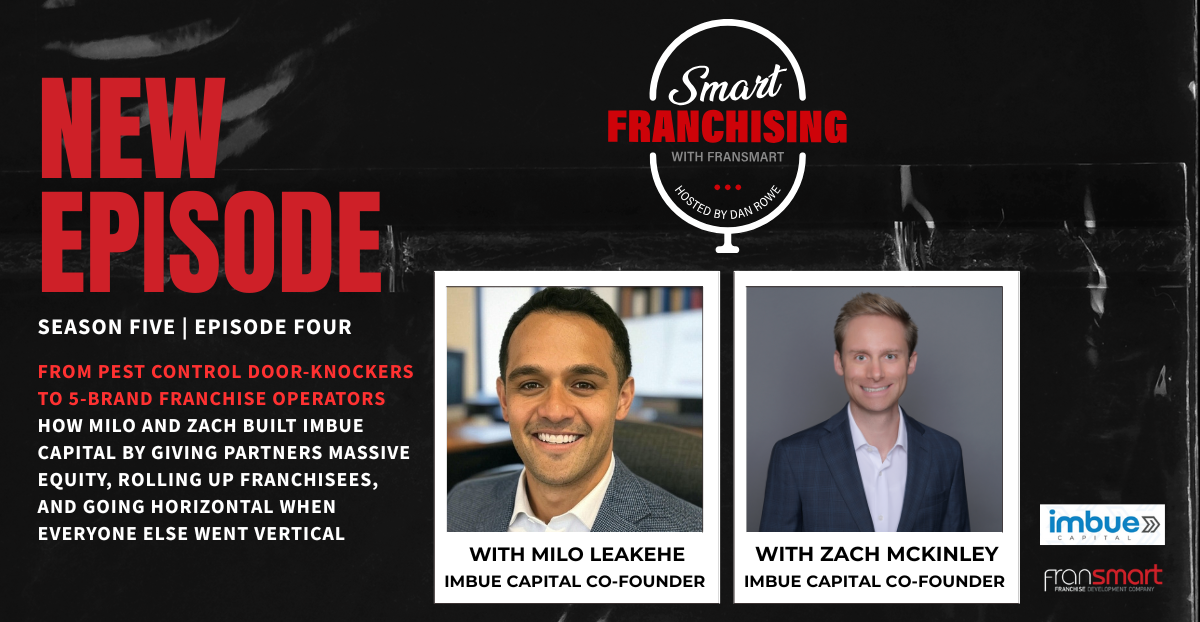
All right, welcome back to Smart Franchising with Fransmart. Today we’re talking with a super Mumbo multi-unit multi-brand Milo and Zach from Imbue Capital. Mumbo is a new acronym for what almost every franchisee wants when they start out in this business. It’s less about the brand, more about what they’re trying to build. Most people want to build big, massive franchise companies. So Mumbo is multi-unit, multi-brand franchise companies.
But the big idea is that you want to build a predictable franchise company so successful and so profitable that you start self-funding, reinvesting your free cash into more units, you know, whatever, however you originally started with raising capital or outside capital, you’ll get to that point eventually where you can start self-funding and compounding your returns. And Imbue is a mumbo. They own a crumble, tropical smoothie, rolling suds, one of our brands, Paymore.
and the sky’s the limit. let’s get into it. Milo and Zach, thank you very much for joining us. Please introduce yourselves. Also what you guys did before franchising and then your journey so far.
speaker-1
Thank you. And I don’t know if we would fit in the category Mumbo, but we’ll take it. So thank you. But with that, a little bit of our background. So Milo and I, we’ve been working together and partners now for close to a decade. And so with that, we actually got started in the pest control industry and we met up while we were in college. We did the whole knocking doors thing where you go out and sell pest control and we learned great skill sets there.
Zach McKinley(02:04.6)
how to sell cycle, how to overcome objections, how to be able to take rejection and grit. So we learn all these things, but we also learn a lot about leadership and building teams. And so I would say that’s where our strength lies is just being able to find and empower very talented individuals. so within the pest control realm, and we’re still in pest control, by the way. So we still love pest control, great industry.
but we’ve owned and operated pest control branches in 12 different states. And so we’ve had a lot of success in that industry, but we’ve also had seven different exits in pest control. And so we’ve sold to strategic, we’ve sold to private equity, we’ve kind of gone through those different experiences. And what ended up happening is when we exited some of these pest businesses, we had built these relationships with some…
incredible operators that wanted to stay with us and keep working with us. And we wanted to work with them. And so instead of going and starting a brand new business and going through all of the learning curves that goes with with brand new startups, we said, hey, how about we go into franchising? And so the path how this came to be, what in view capital is now today is we actually met with these partners and we said, hey, make us a hundred list of
all the top 100 franchises that you want to look into. And then they show us the list, then we narrow it down to 20. And we went through these rounds of pitching where these partners, which we call them operating partners within our organization, would come to us until we narrowed it down to five. And at that point, then we started interacting more and more with the franchisor. We really go into that discovery process until we land on a brand. And what was really cool about that process as we were getting into these different brands that we’re in now is that
We were able to find a brand that fit that operator’s individual skill sets while at the same time we made sure that those unit economics, so return on invested capital, average unit volumes, all those things matched up with what we’re looking for. And that’s how we ended up building out a little bit more horizontally within our company than maybe most franchisees do upfront because we ended up empowering these operators that we already had in the other companies.
Zach McKinley(04:23.906)
And now maybe, Milo, since I’ve been talking so much, maybe you can explain a little bit about our structure as far as managing partner, operating partner, and then maybe kind of the division that you and I have within Embu Capital.
Yeah, so yeah, so currently we’re in five, consider six brands with the plumbing company we just took over. And so I think some people they look at imbue and they would kind of think we’re crazy. A lot of people who want to be multi-brand, multi-operation, they tell you to scale vertically, really big, really quickly. And then once you’re really mature, you go horizontally. We kind of did that with pests. So in our pest control days, each of our locations, they had usually a different sales partner.
And that person was directly responsible for that business, usually just controlling revenue, making sure we’re growing. When we started selling those off, we were kind of left with this funny organization where we had a lot of guys who had just exited. They had made decent cash. They all wanted to be business owners, but they didn’t want to share their equity with any of these other guys that they hadn’t worked with before. And so we thought, hey, this fits in with our goal of getting into five different vertical brands. And so…
We just said, look, you can take one brand, go do your 100 list, make a list of 100 franchises, cross it down. You can have a big chunk of equity in that one. Told the other guy, you exit pest control, you go find another brand. currently, the way kind of our structure works, so every brand has a managing partner and an operating partner. So the operating partner, those for the most part, are the guys that we started with through sales. And we make them sign.
I think we’re crazy for this. We make them sign an exclusivity agreement so they can only think about that brand. They can have their retirement accounts, but they’re not doing anything on the side. Like they live, think, breathe that brand for about five years and we pay them a salary. They get a big chunk of equity and we fund it. We get approved for it. We provide the structure and then the operating partner really what they’re in charge of is building out new locations.
Milo Leakehe (06:29.174)
and then managing the P &L to hit all of our target metrics. And then the managing partner, me or Zach always sits in those seats. So managing partner is number one, controlling funding, making sure we always have funds to finish out the project. Number two, controlling the strategic relationships, which is usually with the franchise or sometimes it’s with our investors or sometimes the banks. And then probably number three is just building the overall.
I like to say like we kind of set the rules that the operating partner has to play in. So they’re all, all these brands, have different rules that they have to work under and we’ll visit together at the start and say, okay, here’s all the constraints and the resources that you have to make work. And we kind of build the framework and then they report up to us. So, Zach is the managing partner for our home service brands. So that’s Rolling Sides, we Pest Control brand, and then Great Basin Plumbing, which is a
plumbing company we acquired. And then I am the managing partner for our retail concept. So Paymore, Crumble, and Tropical Smoothie Cafe. And there’s a little bit of crossover in our responsibilities. We’ve learned that Zach’s lot better in a lot of things than me, and there’s some things that I can help him out on. But for the most part, me and Zach talk a few times a week, and other than that, we’re just working with our operating partners to make sure its brand is running well.
Well, let’s, I’ve got other agenda items I want to talk about. I want to stay on this because this is a secret of success. Some, mean, in order for you to be successful, in order for a company to be successful, you need to have teams of people that only focus on one outcome. Like people that only think on one thing and why you guys are also thinking about the macro and all of our brands and how do we grow in view? Somebody’s got to think about pay more. Someone’s got to think about crumble. Someone’s got to go to bed every night, wake up every day.
passionately trying to move those brands forward. So tell me more about like, it’s not like you don’t just have employees, you got partners. And that’s frankly, for me, I would rather have partners than employees. But I mean, tell me how all that came about. Tell me why you guys wanted to do it. I love that you’re doing I think there’s so much for people to learn about about that subject.
Zach McKinley(08:38.606)
Yeah, so the first thing that I’ll mention is that, I mean, we do a true partnership, right? And so we look at this like, hey, yes, know, operating partner report to me, so I have have accountability, but I’ll also report to my loan, he reports to me, right? So like everybody has an accountability partner, but at the same time with that, we want to be generous. So at Inbue Capital, that is one of our key values is being generous. And when you’re generous, people reciprocate. And that comes back to you.
And it helps us be able to grow a lot faster and do things a lot better. So in our pest control days, we brought on partners and we gave like 5 % equity, 10 % equity within these individual locations. And it went well, but every now and then somebody would get a little bit distracted. They’re like, oh, there’s this other shiny thing. And then they get pulled that way. And we’re like, hey, we don’t want any other opportunity to be better than what we have for our operating partners. So we want to give a big chunk of equity.
So that number one, it sets them up for long-term success, right? This is equity and capital they wouldn’t have access to that they would be able to set themselves up for the future for them and their families. So that’s number one. And then number two on top of that is it’s also identifying, okay, what does this brand need? And so in Paymore, for example, we’ve got 45 units there. We decided, hey, we need three operating partners within that brand.
And so we have those divided up. In Rolling Studs, we have three operating partners. And so they’re over their regions, but there are some brands, so like in Troublesome to the Cafe, we’ve got one, and it’s a different strategy. It depends on speed. It depends on, what’s the skill set that needs to be broad? In Rolling Studs, it’s not as much about operations as it is sales. Like those operating partners are closing deals every day, because that’s the service industry. So we needed some individuals with those skill sets. And so when we are creating this organization,
We make sure that we have the right people in the right seats and that they’re taken care of and motivated. And then the second thing on that, the other reason why we give a lot of equity is we can give them a market rate wage for what position they’re in in the moment. So when we start and we have the first location, they’re in a GM position, right? What’s the salary for that? 50,000, 60,000? These individuals should be making well over 100,000, right? That’s their caliber. And so with that, you’re not going to be able to recruit a manager
Zach McKinley(11:05.154)
that it’s at that caliber and just where you’re at, right? You won’t be able to afford it. And so that’s why we go with that route. And then also it gets hard sometimes, right? Like there’s ups and downs in every single brand. And if you’re just got a hired manager, he’s not sticking with you in those hard times. He’s not there rolling up his sleeves, making it happen. It gets tough. And so we want guys with us that are ready and willing to go and attack any problem that comes our way.
You’re basically aligning their compensation with your goals, right? So it almost doesn’t matter how much they’re making, because you give them a percentage, you can’t spend a percentage, you can only spend money. And at the end of the day, if you wind up giving these guys $5 million, whatever, if you sell that business unit someday, think about what it makes you, right? And you’ll get some people that are like, yeah, but you don’t have to pay that much. It’s like, I made $10 million, right? And so people don’t get it.
People don’t get it, but that’s, think it’s a secret. It’s an absolute secret is aligning. you’re trying to get wealthy in this business and you want to rely on other people to do it for you, right? Which is your, your team. You have to align their compensation with your goals and let them make sky’s the limit because if they’re making an unusual compensation, you know, base carry bonus, eventual liquidity, if they make a huge amount of money, think about how much they’re making you guys. And then.
And you have somebody every single day who’s focused on this business and it frees you guys to go out and go do plumbing or whatever else you guys get into because you still have someone who every day is only thinking about crumble or only thinking about pay more. think it’s smart. So, I mean, I like that you guys are doing that. Anything else that you could tell, like if somebody’s listening to this, like any advice or any thoughts about why they should consider doing this or how they should consider doing this.
One question I get a lot is how do you pick the right operating partner? And I didn’t realize, I’m realizing more and more that that is a resource that Zach and I have tapped into that I think a lot of people struggle to find. So our standard operator, operating partner, they’re usually really young guys who a lot of them don’t have college degrees, but they’re just really young. They’re really ambitious. They’re really gritty. I think gritty is a really good word.
Milo Leakehe (13:29.624)
You know, these are guys who, I mean a lot of them were door knockers. These are guys who will show up and knock door to sell pest control.
Milo Leakehe (13:38.518)
It’s miserable. But I think, you know, we fortunately tapped into a really big network of just these really young, ambitious kind of guys who want to be, you know, they’ve had their experience that sales, they felt what it likes to, you know, kind of eat what you kill and want to become business owners. And so we fortunately tapped into this big network where we’ve found guys who are willing to move all over the country for us. They’re willing to take a little bit of a lesser salary now for a bigger payout later. And
I think talking with a lot of other franchise owners who are looking for operators, it seems like a lot of them are sourcing, I don’t know, guys who used to work on like Fortune 500 or former attorneys who already have like $150,000 in life expenses. And I feel like once you hit a certain age, your ambition and that grittiness and willing to put in the hours, it kind of dies. And so I think if I were to source operators, I’d go, I’d just go to college campuses and find the really young, they might not know what a P &L is or how to…
manage cogs, but if they’re young and ambitious and hungry and and gritty, know, gritty is a really good word, then you can teach them everything they need to know to run a business.
And then without giving specifics, like the kind of upside someone has, like if I were your operating partner for a particular brand and I kill it the next five to seven years and this company eventually you guys sell the brand off like when it’s still at its peak. My portion of that is millions or hundreds of thousands.
millions.
Milo Leakehe (15:05.89)
Yeah, millions,
Because that’s the big difference. It’s like you’re not talking about paying. Most people pay people what they have to to keep them, right? You only, you know, what’s the first thing whenever you look for a guy that wants a job, you’re like, what are you making now? Right? Because you’re always just trying to just put a little bit more. And so people tend to pay only what they have to to keep people instead of saying like, you’re allowing someone that doesn’t have any money to eventually have generational wealth. Generational wealth.
and you’re gonna make it in franchising and they’re gonna make it on hustle and execution. Like they don’t come to the party with a lot of capital. They’re basically coming in here and you know, whatever you raise around the first, you know, call it paymores or crumbles or whatever, they get that business to the point where it’s starting to sell fund and it’s starting to compound and grow like crazy. And then you buy out some weak franchisees, really turn that thing into a significant business and you sell that someday. That person’s
Generations now have capital, right? That they didn’t have. And you’re offering it, but the whole thing is you’re not giving it to them. They still have to make it. The operative orders make. You can make yourself generationally wealthy, but the operative orders, you gotta make it. But I like that. And the other thing that you said that I love is we let our partners pick the brands, right? The worst thing that you can do is have someone, you put somebody in a brand that they’re not congruent with. So let’s say, you know, you’re a Five Guys franchisee and…
You tried to stick in a vegan operating partner, right? Or I don’t know, like as someone who’s, you have a fitness franchise and you bring in someone that just doesn’t value a healthy lifestyle. It’s like, it’s incongruent. So if you let someone say, I actually think like you went from a hundred brands, you narrowed it down to five, but in large part, those came from pairing up people on the right brands. How do you guys go about doing that?
Milo Leakehe (16:54.956)
Yeah, so the cool thing is a lot of that search process is led by them. We’ll kind of direct it. So if we have someone who wants to become a new operating partner for us, first thing we’re going to say is get out an Excel sheet and start making a hundred list. And, you know, we tell them just like, you know, drive down the street. What businesses are cool? Like throw those on there. And everyone always starts with like McDonald’s or Chick-fil-A and then they find out you can’t franchise a Chick-fil-A. But then, you know, usually once they’re past like 15, they really have to start thinking and doing their research.
So we’ll get a hundred. On that list, we have target criteria that this has to fit in. So, you we don’t like businesses that can’t hit an AUV of at least a million dollars a year. It just feels a little scary to have that little revenue. We like businesses where you can, under the right conditions, get your money back in under two and a half or three years. So there’s certain ratios between the average profit, average initial capital invested and the total revenue. And we
We also have lots of talks with them about, like I was just talking with another kid who wants to be an operating partner, haven’t made any promises, but he’s like, where am I gonna live? And I was like, you can either be picky about where you live, you can be picky about your work-life balance, or can be picky about your business, but you can’t be picky about all of those. So most of our operating partners are from Utah, none of them are living in Utah, they’re all over the South. And so there’s a lot of conversations over like, hey, if you want.
a financial goal, you might have to be really flexible with where you’re dragging your family out to the next five years. So, but yeah, we’ll fill in all that financial information on the hundred list and then we’ll just go through rounds of chopping it down. Once we get to, you know, usually around 10, that’s when we really start having conversations with all the franchisees of that brand. We start verifying, we start building out full pro formas for each of those locations. We start doing financial verification to make sure it’s is what’s, you know, advertised.
And it’s kind of cool because so I’m saying we’re doing that. That’s the operating partner doing it. We’re telling them what they have to do. They go do the homework. And at the very end, they’re really the ones pitching us on this is the business I want to do. This is the business I believe in. And it’s been that was very intentional. We had some partners on the pest control side. You never want to sell someone on being your partner because things are going to get tough like they always do. Nothing ever turns out to be as you expect it.
Milo Leakehe (19:18.798)
And if me and Zach are the ones selling them on like, look at this great business I found. When things get tough, who are they going to point the fingers at? It’s going to be the guys who found the business. You talk me into this, you drag my family out. But the way it’s set up now, and we’re very open with guys from the start is like, hey, all businesses are going to have their hiccups. You’re going to have good times and bad times. I think it’s a little bit easier when you run into those hiccups if they found the brand. We disclosed everything we could think about about how this could go wrong. And after it’s
Bye.
Milo Leakehe (19:48.27)
trying to scare them out they’re still on board you know those ended up being really good partners.
So Milo, are you suggesting that not all franchises are as advertised? Come on.
How dare you? Hey, so it’s funny, and I’m so glad, like every time they come up with a new rule in the FDD, they’re all there for a reason. It’s because people keep getting hosed, you know, like even the changes to how you disclose item 19, like they really are in everybody’s best interest. But what are some of the other things that you guys look for? So like someone wants, someone’s gonna hear the podcast and say I want you to be my franchisee. What are some of the…
you know what sort of you on your criteria list.
Well, I’ll go first. I mean, just to kind of follow up. So this is, you know, to be a partner, an operating partner, and then also into the franchise system itself. one additional thing I just want to echo is this isn’t like you go and you put an Indeed out to find some gritty, hustler type person that you want to partner with. And so I do want to mention that with the exception of probably two, all of our operators have worked with us for a significant amount of time before.
Zach McKinley(20:56.76)
So I’m talking seven, eight years. And so we knew their strengths, we knew their weaknesses, they knew our strengths, they knew our weaknesses, and we knew how to work together well and that they have the capabilities to do the things that we need. So whenever I’m hiring an employee, it’s GWC, did they get it? Do they want it? Do they have the capacity to do it? If you’re bringing on a partner, it’s even more than that, right? Like this is somebody you need to align on risk tolerance. You need to align on, hey,
What do we want to do with this business? Are we going into growth mode? We want to scale this or is this or in other words, are we going to just redeploy our capital, reinvest in the business and keep growing? Are you looking for dividends? Like these are all things that you run into within a partnership that gets very difficult if you’re not aligned at the beginning. And so, I mean, I’ve had almost 40 partners that are actually operating in the business over the years, not investors. These are just operators day to day in the grind.
And some have gone extremely well and some not so well. And most of those that haven’t gone well, we haven’t been aligned on some of those things. Great individuals, great operators, or they’re selfish, right? Like we’ve had that as well, right? Which is difficult when you have a partnership. So, I mean, that’s one other plug there. But once we have that partner and we’re like, hey, let’s do this together. We’re looking for a brand. Like the brand needs to make money, right? We’re not doing this in order to like, hey, like feel good.
Like, yes, I want to contribute to society. I want to make sure I believe in the brand and the vision and like all the things that are there, but they need to make money. so Milo mentioned where we build these pro formas. And so we have the break even like, if we go into this brand, here’s the minimum amount of revenue that I need to do in order to break even. And now how do I make a profit? Right. So we have to figure that out and you don’t do that through the item 19. There’s some good information there, but
That’s when you have to call those franchisees, every franchisee you can. I mean, when we went into Paymore, Jake, our operating partner, he called every single one. Granted, there weren’t a thousand franchisees, but he literally talked to all of them, confirmed the P &L data. So we extracted that information from those franchisees, put it into our pro formas, looked at the breakeven to confirm, okay, this is where the unit economics of this business are. And okay, can we work with this? How does this work over the next five years?
Zach McKinley(23:17.41)
How do we grow? How do we scale? Because that’s another thing that we want. We’re not looking for a lifestyle business that it’s like, hey, we get one or two locations. This is nice. I bought myself a job because that’s what you do when you only get a couple locations. It’s like, hey, we want to scale this. We want to grow something big and impactful. And so in order to do that, you have to be in the right brand. Anything else you want to add, Milo?
ends it.
Milo Leakehe (23:38.574)
No, think so franchise specific in the search. So I think we’re we’re pretty agnostic about, you know, certain segments or certain industries. We just like business. think all businesses can work. They can look really different. But there are some fundamentals that absolutely have to be in place. So one of the reasons why you franchise is it should take a lot of the risk out of being an entrepreneur. And part of that is you can wait for like 10 or 20 or 50 other people to go try it out.
before you put a ton of money on it and then if 50 other people can do it, it’s like, all right, can we be one of those 50 people? So we’re always a little cautious about brand. If someone doesn’t have a single location now, I think we’re gonna scratch that off the list. We might as well go start our own concept at that point. It feels really risky. So I think we like locations. I know we’ve done some new concepts like Paymore, Rolling Suds, those are new, but when we got in, they had at least two dozen franchisees.
Operating that we’re able to call the things that I’m trying to validate when we’re building a pro forma So when we’re looking for a new franchise we build a pro forma and the first thing we’re validating is all of their advertised financials so number one we’re gonna validate how much is this gonna cost us to invest and Sometimes that well, there’s one brand we’re in it’s turned out to be a lot less now that we’re in it than advertised Seems like the most often than not. It’s like two twice as much as advertised
on that. So we’re validating the build out cost, the total initial investment. What is the FDD not thinking of? We’re trying to get a total investment cost number for that brand with working capital. Like how long are you going to run at a loss? Is it three months, four months, five months, six months? And number two, we try as much as possible to validate every line on the P &L to get a good breakeven number. In retail, I think, so it’s different on the
Home services brand, this probably isn’t as important because you control revenue more. But in retail, I’m really trying to validate revenue because if your revenue is off, it doesn’t matter how good you control your cogs. If you’re below your break even point, you’re just going to lose money forever. And the hard part with retail is if you just pick the wrong location or the right wrong brand, it’s really hard to increase your revenue. Home services, we can always increase our sales funnel.
Milo Leakehe (26:01.102)
and it’s a little bit easier to control revenue. So I’m trying to validate the revenue. And I think one thing, one mistake I’ve seen a lot of new franchisees make is number one, they never validate. They’ll just take a call at the salesperson and be like, oh, this seems awesome. And I’m like, you would never make a $500,000 investment without doing a lot of read. But I’ve talked to so many people, they’re like, oh, I talked with the salesperson. He told me.
the average franchisee is making X. And I would just pretend that that person doesn’t exist. And then the second big error I see franchisees making is the numbers look good if you’re in the top like 10 % and they just assume like, I’m gonna be in the top 10%. And I would be terrified of that. The more we kind of did that when we got in, the longer I’m in business, I kind of just say, plan on being in the bottom third. If this still makes sense in the bottom third, home run. Let’s go do this pull throttle.
But if your plan is having to be better than half of everyone else who’s doing it, who are really smart, driven, motivated people, that’s a gamble. if it works for the average person, great. If it works for two thirds of people in the system, we’re just trying to mitigate risk a little bit. So there’s a long answer for you.
Yeah, when you talk to the sales guy, I mean, one, shouldn’t be saying anything that’s not in the FDD no matter what. If you ask the sales guy, like you say, okay, I want to do some diligence and talk to franchisees. Who do you think they’re going to give you to talk to? They’re going to give you the happiest, most referenceable, you know, people. And it’s worth actually talking to some unhappy, maybe even some unsuccessful because it might, it might.
teach you something about the brand that helps you decide if this is the right fit for you. It gives you something to counterbalance the people who are saying good things. But it might also be someone was unhappy with it because it was sold as a passive business, which a lot of brokers are marketing businesses. Hey, this is a passive business. It’s an ATM machine. And it turns out that that’s not the case. And this guy thought he could run the business from Maui and he can’t. And then it at least helps you understand. But I think that’s smart. If you guys have this decision criteria,
Dan Rowe (28:13.678)
and you’re like, tell me some of the bad things you heard and how are we gonna get around that? I think that would be smart. One other thing you mentioned about your financial models. I don’t know if you ever, we had a CFO that worked with us for a couple years, Mike Winnie, he’s awesome dude, but he created these financial models that basically mimic a franchise that you’re gonna sell someday, right? So it’s like, hey, you’re gonna buy Dan Roseburgers or whatever and you pay this much to sign up.
this much cap X and then the first store generates a little bit of profit. So a little bit less money on your second, a little bit less money on your third out of your pocket. And then at some point it’s self funds compounds grows into a franchise company. And then someday you sell it 10 years down the road. I always believe franchisees should think that way. They should think about not the franchise company I’m buying the franchise company I’m selling. Like I’m buying this franchise. I don’t have to sell it.
but I wanna know like it crumbled. Like at some point I know, like I’m carrying some number that’s a realistic number of what we could all sell this company for today. And I think people, if you also look at that, it gets, and especially the way you guys do it, where you guys have partners that actually get a piece of that eventual buy, you get what you focus on. And if you focus on high profit and a high resale price, you’re gonna get high profit and a high resale price.
where so many people just focus on, I mean, I can’t tell you how many people buy a franchise and they want to know what the break even is. And I’m like, why are you buying a franchise to break even, right? You’re buying a franchise to sell this thing someday for a gajillion. So that’s good. Any other thoughts that you have or any advice, like if someone came to you and said, Hey, I want to do what you guys are doing. any other war wounds or any things that you guys did that you wish you didn’t do? Like most of what I know came from doing stupid things that I got my ass kicked for.
Yeah, I think a lot of skills going to franchising you can develop, but you should probably have a decent sense of like building out finance, just a basic model, you know, and then I think also realizing, so I won’t tell you which brand, one of the brands we realized quickly, FDDs and franchisees, they’re talking about their profit, they’re talking about four wall eboda.
Milo Leakehe (30:30.626)
They’re not telling you about their area manager cost or they’re not telling you about the debt service payments they have on that. So when you kind of build a model for some brands, it might look really, really, really good if you can pay that all out of pocket and you’re running it yourself. But if you’re planning on getting like an SBA loan and you’re planning on having someone else run that, those are two costs that aren’t advertised in that average profit and it might totally kill the profit.
I’d be mindful of that. can’t pay bills with EBITDA. It looks good. It’s good for resale value, but you got to pay bills with true cash flow. So I think that’s a big that we got in one of the brands we’re in. I wish we had understood that. Those are the first ones we did earlier. And then we me and Zach now say this all the time, like every brand, it always costs more than you think. And it always takes a lot longer and it’s always a lot harder. So be well funded. Plan for it to be a lot longer.
and lot harder and then if you beat your expectations, you’ll be stoked.
Yeah, you said something. EBITDA really is a BS term. is a BS term. Because it doesn’t include amortization. And it’s like, if you guys have that oven at Crumble that you pay whatever, that thing doesn’t last forever, right? You’ve got to replace it every five or six years. So whatever that thing costs divided by five or six is what you lose every year. And that model that Mike made, which by the way, if anyone wants a copy, just email
Dan at France Mart, I’ll send you a copy of the franchisee model. It captured that. So he actually had something that captured unit level, multi-unit, taxes, reinvesting, post-tax, I mean, all every, it was a very, very, comprehensive model that all tied to an eventual purchase price. So you’re exactly right. cannot look at item 19 is EBITDA. It has, you know, most franchisees aren’t buying this for a job. They’re buying it to build a franchise company, which means you need a GM.
Dan Rowe (32:31.256)
You need a multi-unit oversight. need bookkeeping and accounting. Like you said, you got repairs and maintenance and depreciation and you might have some debt service and you got to factor all that into it. That’s actually, that’s good advice.
Maybe one last point on that. So I think once you build out your model and you confirm all of those assumptions for the target costs, you need to realize once you open, those are target costs for a reason. So sometimes I’ll talk with brand new operators who’ve been around for six or seven months who are feeling some hardship. And I’ll ask a question like, well, what’s your target food cost? Or what’s your target labor cost? And if they give a pretty vague answer,
I know that number is way out of control and you know, probably losing money. So the best operators that I’ve met, you know, they’re like, yeah, I know my labor has to be 23.5%. My food cost has to be 20 % and they’re very, they’re very, very, very mindful of those numbers that they have to control. And because they’re mindful of it, like you said, they control it. And I think a lot of new franchisees that get into trouble, especially if you’ve never owned a business, they just get in there and they start.
running their business on vibes and good feels, but you have to be really controlling of those controllables. If you’re not controlling your controllables, your costs will take over. So I’d be mindful of that also.
Well, and we have like one of our training with our franchisees is we make them track CapEx separately from their operating because so many times you open up on day one, well, you still have general contracting bills for the next couple of weeks. most, you know, lot of franchisees, especially first time franchisees, they just operate out of a checking account and one single checking account and they’re managing CapEx and they’re managing their operating company and every two weeks is payroll and.
Dan Rowe (34:18.414)
Even if they’re busy, they’re like, man, I’m not making any money. And so any advice that you have, any more advice or can you confirm that how people need to track your CapEx is different and then look at your P &L and to your numbers. Remember, you just did your diligence looking at item 19. You like it because it’s got a certain food, paper, labor, arguments. You got to go back and look at those things from day one. Otherwise, if you’re complaining that your numbers aren’t good.
you brought up a sore spot with me. We get franchisees sometimes that are complaining that they’re not making money and you ask to see their financials and they say, I haven’t even had time to put them together yet. You’re like, well, how do you know you’re not making money?
Yeah, yeah that always scares me when people don’t have live financials It’s like driving a car through the rear view mirror, know, like you can’t do it You have to your financials are your dashboard and maybe you can’t get them live But if you’re not reviewing those financials, how do you make business? A lot of times you say your P &L should make a lot of your business decisions for you And if you’re not using your P &L, I don’t know how you make if you’re making decisions with your finger in here, but it’s kind of dangerous
P &L should make your business decisions for you. I’m gonna put that on a t-shirt, I like that. I’ll give you full credit. I cut you off, Zach, what were you gonna say?
Vote me on that one.
Zach McKinley(35:36.194)
would just, mean, it segues with this perfectly, because I mean, if we look at battle wounds, and we could probably spend the next 30 minutes talking about these, but I mean, I think when we have lost money or we’ve missed opportunities, I mean, a lot of the times it is when we just get busy and we take our sites off of those metrics. And so, I mean, if I talk about when we first went into retail, so we started Crumble.
and a little bit of our experience. we went and we were transitioning. So I had done Pest Control and then had a startup called TrueWear, men’s clothing company, great brand. But that was part of the reason why I went into franchising because I went through, know, hey, here’s SOP version 21 because we had to reiterate these processes so many times. So we were excited about having the playbook. And so we first got into franchising, but we were used to building these growth companies. Right. And so Pest Control,
our strategy was, hey, let’s put a ton of debt, lever these up and essentially be positioned for a lucrative sale because we knew the spread, we knew the multiples, we had strategic buyers that we’d already pre-negotiated LOIs in a lot of situations. And so with these, we’re like, hey, we can go and put a lot of leverage and we’re going to take the spread on an exit. And with that, we were looking at the margins. We’re like, hey, Crumble’s margins are incredible for a QSR space.
and they are and they still are. But with that, we went into it thinking, hey, we’ll just focus on operations and these quality metrics from day one and we’ll worry about the financials in a few months is the way that we approached that. Can I tell you how much money we lost because we took that approach? Right. Like it was just so crazy. it was I mean, there was chaos. mean, we had lines out the door for the first two months at our first Cromwell location. It was incredible.
And Milo and I were working 20 hour days literally in the store. Milo passed out. It was pretty bad. I was talking to him and his eyes rolled in the back of his head. He just fell straight on his back. It was bad. But it was just we weren’t ready for that kind of volume. It was incredible. I mean, we did $270,000 in revenue in the first 20 days. And that was crumble. And it was incredible. like it went extremely well, but
Dan Rowe (37:50.39)
What was that, Brandt?
as crumbled.
Zach McKinley(37:57.378)
We weren’t ready for that kind of volume. And then we just threw labor out the door during that time. We’re like, Hey, there’s this volume. Like we’re just trying to keep up. Like we got a two hour line out the door and we lost so much money because we weren’t controlling labor. We went back and we calculate it. We’re like, wow, like we missed out on so much opportunity there. And we have repeated that. Right? So it’s like one of those where we get our mind, like our sights off, we get super busy. There’s chaos. Things are going well.
but we lose track of those numbers that actually make it work. And all of a sudden we’re like, hey, we just lost another $100,000 in opportunity costs if we just would have been paying attention to labor again or whatever the metric is. And so you need to be diligent and make the time for those accountability checks to make sure you’re hitting your targets. Otherwise, you’re just spinning your wheels. You’re busy, but you’re not making money.
Yeah, no, you’re right. Your heart’s in the right place. You’re just, because you’re thinking about the guests, you’re just throwing things at whatever makes the guest experience good. In hindsight, you still could have done both. You still could have had a great guest experience and managed the numbers. But yeah, if you’re gonna pass out in any business, the one to pass out in is in a crumble into a pile of cookies.
in a bakery.
into a bakery. Hey, so let’s shift gears a little bit. Let’s talk about something fun. So you guys started this business with the idea. I mean, I like like you have multi units, multi brands, multi partners. It seems like the sky’s the limit for you. You need to keep finding great brands and partners who will execute on those and then capital sources, right? And that’s those are sort of the pillars. Everything else is important, but those are the three big things is you got to pick your brands carefully.
Dan Rowe (39:41.358)
But what’s the big picture? Like how many locations do you have now? Like what do you think about? I want to get 10,000 units or what’s your big idea?
goal is by December 31st, 2032, 100 units at at least 1 million AUV. And the plan is it’s probably going to be seven verticals right now. We’re in five. That’s been fun. That’s the best. So when we talked about operating partners, you know, we don’t pick the brand for them, but we do have a vision. And I think a lot of these guys, they wouldn’t leave their, you know, high paying job to go be a food operator at a decent salary, but
That’s the vision is what can I think that’s one of the most fun things about entrepreneurship is no one’s dictating what the future looks like. You get to kind of draw it out on a whiteboard and there’s just a bunch of hungry people trying to create the future. And I think if there’s one thing that’s motivated operators more than anything, it’s that long-term vision that’s hard, a little risky, but you know, just something that you can build on your own. And that’s my favorite thing about being an entrepreneur is you get to make the future whatever you want.
You know, and if you want it bigger than what we’re envisioning, you can make it bigger. there’s no one sitting. It’s a double-edged sword. There’s no big company protecting you when things get scary. You’re kind of on an island. But if you believe in yourself and you have confidence, you can kind of create whatever future you want.
Yeah, especially in this business. mean, really is sky’s the limit. You guys will get to a hundred million. The hardest part will be for you guys to get to a hundred million to go from one zero to a hundred millions hard to go from a hundred million to 200 million is just a couple more years. It’s not, it’s no more hard. And then it just starts really rolling. But you know, like one good rule rule of thumb is for a franchise company. When you look at what units throw off in profit and then what they sell for us a multiple is
Dan Rowe (41:31.756)
A lot of them sell for one times cash. So if you guys build a hundred million dollar company, theoretically it’s worth a hundred million dollars. Like that’s a lot of money to enrich a lot of people. So, but yeah, if you guys get to a hundred, there’s no reason you don’t just continue to 500. Right. And so, that’s great. But what, what, with investors, so it’s called imbue capital or do you guys have your own pledge capital or are you syndicating as you guys need projects and
I wanted maybe just for people that have never raised money, want to get some tips and tricks for people to raise money, but how are you guys capitalized and structured and all that?
So I’ll start answering this one, and Milo, you can add. So essentially, we have self-funded most of this, and so the equity infusements have come through those exits from the pest control companies. And so we’ve rolled those exits mostly into what is in Butte Capital now. And then we’ve used different forms of financing in order to leverage up and be able to go and scale. And so we’ve used the traditional bank financing. So we’ve done a little bit of SBA. You got to jump through a few more hoops.
We’ve used what you know, they call the express loan there where we you know, it accelerates that closing process Which is nice and that works really well for certain brands like trouble smoothie cafe. Thanks Love to lend a trouble smoothie cafe. That’s super easy to underwrite with the bank But you’ll have some newer concepts or a lot of times in the service industry traditional banks don’t Don’t have an appetite to lend to those businesses. And so we’ve also we’ve got a network of
I mean, we call it personal finance, but they’re essentially hard money loans. So we’ve got a network of wealthy investors that we’ve proven ourselves over the last decade of just having success, returning their capital and being good to work with where we go to them, we say, hey, we need another $500,000 or we need a million dollars. And we’re able to get good terms that I would say be probably what the market rate is on hard money loan.
Zach McKinley(43:36.002)
just because of that relationship and we’re able to fund some of these because of that. Now with that, you’ve got to be careful because interest rates are a little bit higher. You need to make sure you underwrite that properly and you’re not just doing, hey, I’m going to bank finance, you know, 70 % of this and do a hard money loan for the other 30, right? So that doesn’t work. But with some brands like Paymore, we have taken, for example, some hard money loans or some private credit.
because we’ve run the math and we can pay that back within a couple of years. So if I say, hey, within two years, I know I can totally pay back this loan, then I need the term on that to be three years because it never goes as you expect. And then you also need to make sure that your runway is such that you have, whether it’s other liquidity events or other forms of capital coming in that can supplement that if you need to pull from that you can.
And so with us, when we’re looking at financing, we’re looking at those things. We’ve done bank, we’ve done personal credit, and then we’ve also gone the private equity route. And so that’s a different story. I private equity, they don’t really usually like to touch anything unless you’re looking at two and a half to three million dollars in EBITDA. And it needs to be a little bit. You need to be playing at a bigger scale in order to do that. But we’ve only done that. So in one of our brands.
we have done half the brand with private equity. So it’s like, hey, this $4 million that we raised through PE is going to support the growth of this region. And then we’ve done the other region ourselves so that once again, we’re not giving up so much to PE. But then, I mean, right now we’re in the middle of due diligence of a pretty large acquisition that is working through private equity. But once you get into that, you get into the…
high dollar amounts, all of a sudden you’re dealing with quality of earnings, higher attorney fees. It gets a lot more complicated very fast when you get into that sophisticated capital and you’re meeting with these sophisticated investors. But it’s also super exciting and super fun. But starting out, it has to be more on that, your local branch, you’re going, you’re setting up or this local broker, an SBA loan or whatever it might be.
Milo Leakehe (45:53.294)
I think we’ve yeah, we’ve funded these on every spectrum of funding out there. I think the more mature we get we’re really liking Acquisitions, I think a lot of people are afraid of the word private equity They think there is this some cutthroat Wall Street guy who’s gonna which does happen So I guess can be careful, but I think probably our future is turning into a lot more private equity backed acquisitions and Loving the strategy I think
A great, I talked with one of my friends I went to law school with. He’s working on Wall Street and he’s liking it but wants to leave and he said, way I would do it for some of these like people who have a really good professional background, go run like one or two or three units, run it profitably, show that you know what you’re doing, and then go use your background and your resume to go connect with these people. lot of private equity realizing, very interested in franchisee rollups.
But there’s this huge disconnect where a lot of your franchisees, they don’t really speak the language of these finance professionals and kind of vice versa. And so a lot of the franchisees are scared of the private equity guys. A lot of private equity guys, when they talk with them, are like, this person doesn’t sound like we can put $20 million behind them. But if you have a decent resume, if you have a professional background, I think you leave your professional job, run three or four or five stores.
and then go network with these big private equity shops and get them to back someone with a professional background to do large acquisitions. So I think, you know, we’re leaning more and more into the kind of the roll up strategy. And I think that’s going to be a big part of our future.
In that, you guys said a couple things. One of them is even the mere fact that you guys are having conversations with private equity guys today, do you remember when it was first Zach and Milo hanging a shingle? How many those private equity guys were having conversations with you? That’s what happens is eventually you’ll get to that point. You guys have built a real company with a real track record. People have to think about as much as it seems like I’m slogging through my first year or two, you will.
Dan Rowe (47:57.142)
if you do it right, get to that point where you have options. And so now you guys have options of PE companies, because think about it, private equity guys are fricking salespeople. PE, all investment bankers, private equity, they’re basically salespeople. They’re selling deals, they’re selling money, period. They get paid to do a deal, like they wanna do a deal. so, know, sales guys, like anyone else, they’re selling. And so they like you because you guys are proven.
and you’re bankable, you’re sellable. like, and then you said something else a second ago, you’re able to go to your existing investors when you need to because you already were successful with them. The fact that you guys already took care, and this is good advice for people. Like if I ever, don’t go out for, I don’t need to go outside for capital anymore, but if I did, I could go back to people I’ve already done deals with because they’ve made a lot of money on us, right? The people who did really well on.
handful of our brands is like those guys are happy to get involved. And so, you know, you guys have done two things you should probably give yourselves credit for is like you have options to go to banks because you’re because you you operate successfully. You have options to go to prior investors because you treated them right. They trust you. They believe in you. And now you’re starting to get P interested in you. And again, that’s all because of what you’ve built.
So people have to think about like, you know, this is a long-term, this is a long-term thing. One last thing I want to ask is if a brand, and this is so important, I don’t see enough franchisors focusing on this. Franchisors should secure options for capital for their franchisees. Cause if I’m pitching you guys on, take my new widget company and you’re like, Dan, you’ve only got six units. I mean, I know what that call is going to be like when I call my local bank.
I know my PE guys aren’t going to want it. know that my wealthy investors aren’t going to want it. And even the SBA is going to make me jump through hoops and double, you know, guarantee this, this loan. But if they bring you, I got the widget company and here’s a leasing company. Here’s a S I’m already pre-approved with the SBA, which is the easiest thing in the world to do is to get pre-approved with the SBA. And I’ve got three lenders who are okay that we’re an emerging brand as long as it’s a high net worth franchisee or someone with a background that matters to you guys. Right.
Milo Leakehe (50:18.83)
Yeah, yeah, absolutely. If it’s already pre-approved financing or they have a, I think especially on a new brand, it just makes it easier for franchisees to dive in, you know? And that’s one of reasons why we love Tropical Smoothie. It is the easiest brand out there to finance. I don’t know, I think it has a combination to do with they have a long track record, but a lot of the lenders we’ve met with, they’ll rank Tropical Smoothie as like their top one or two or three franchise concept to lend to. It’s our second location we got
Why is that?
Milo Leakehe (50:48.302)
fully funded in under 14 days from starting the process. So it’s awesome.
Yeah, and with that there is a credit rating within the franchise system which I mean I’m sure Dan you could talk to this but it goes in, ranks the different franchises with the banks and says hey, this is somebody that we want to lend to or hey, this is lower on the list like the credit rating for this franchise or isn’t great. And so with Troublesome at the Cafe, they’re one of the top out of like a thousand different franchisees that are on that list for banks and so people get really excited about that.
And that’s why it’s been so easy from a lending standpoint with Drop a Smoothie Cafe to answer that question.
Yeah, we, we, mean, we always have sources of capital. we have, you know, leasers, we have SBA, we have conventional, I have PE guys, I have just wealthy family offices that want to invest. And so we like, we have all these, we keep them in our back pocket and we try to make the right fits at the right time. But that’s one of the reasons that you see us selling so many franchises and emerging brands is like, you know, not only are they high performing and they have good numbers and all that other stuff.
But I think about all the things that a franchisee needs. You know, they need good unit economics. They need it to be profitable enough to be able to pay a good staff. They needs to be profitable enough to quickly get to the point where it’ll self-fund. And it needs to have capital. It needs to have funding. So we’re working on that. We have a new emerging brand in our portfolio and it needs drive-throughs, right? That’s a lot of capital. Like buy land and build a drive-through.
Dan Rowe (52:20.588)
And it’s like, we just secured two people that want to actually pre-fund Build the Suits. And for an emerging brand, that doesn’t happen every day. But I don’t know, I think you guys are, you know, that’s, I think you guys are doing it right. So what is it about 2025? Could you guys, I mean, is there anything about 2025 that makes you feel like today or next year is going to be any harder than it’s been? Or is there any reason you guys aren’t going to get to a hundred million dollars because of, you know, tariffs and
inflation and you know I feel like in my 35 years there’s just always been something and yet yeah people 400 million people in the US they wake up hungry every day there aren’t you know
So we, it does feel like it’s a little bit of a recessionary environment out there right now in 2025, which is fine. I think if you’re in business long enough, you just have to plan for some downturns. That’s just what it is. So one of the risks we knowingly took big in 2024 and start of 2025 is we went, we expanded really quickly, really fast. We knew that was going to require a lot of capital to just.
get these businesses running and making money. So yeah, we said, hey, this is a bit of a risk, let’s go horizontal fast. And we kind of said going into 2025, as long as we have enough capital to whether slow build outs or slightly longer stores to get past breakeven, we’ll make it. I think that’s probably where we’re at. We haven’t gone the extreme routes of like, we’re running out of money, who do we call for capital? So if we can make it through.
probably the next six months without having to go dial for dollars. You know, I think it’s full sprint to 2032. Kind of like you said, just, gets easier and easier and easier as you get bigger. And I think that’s probably 2025 right now. It feels a little recessionary. It feels like some of the average unit volumes are slowing down a little bit. So do I think any of the businesses are going to go under long-term? No. Do we have enough, you know, reserves to weather?
Milo Leakehe (54:25.836)
six or seven or eight months, I think that’ll be the test going forward.
Let me know, I can help you guys find capital. I think, mean, anytime, like think about it, when do you wanna buy a stock at the peak or at the valley? When do you wanna buy real estate at peak or at valley? Everything goes in cycles, right? And if we are in a recession and if it is soft right now, I almost feel like it’s a better time to make a deal.
Yeah, especially buying other franchisees. I think there’s a lot of franchisees at some brands who are feeling a little nervous and what better time to buy.
when you can get some terms with some seller financing. We didn’t really talk about that, but we’ve done probably three different acquisitions in the last six months that were seller finance and with
I like that,
Dan Rowe (55:08.503)
So, pretend I’m a third grader. What does that mean?
Yeah, so essentially we go, we start the discussion. Somebody’s interested in selling to us and you can sell our finance all across the board, which means that the person that’s selling the business is going to what we do is we set up a promissory note and we have terms. So usually five years, we give them a little bit of return on that. Let’s call it five percent. But essentially they are financing our acquisition.
Right? So the seller is financing the purchase price. And by doing it that way, that gives you the ability to make some acquisitions that you might not be able to do otherwise. Otherwise, and in addition to that, you can also do acquisitions pretty darn fast. Right? And so add some where we’ve put very little money down, but we’ve been able to sell or finance most of it. And some of these guys, I I was talking to somebody the other day, and this wasn’t a deal that we did, but they did a 10 year note.
And the reason why is this person was retiring, it was a good business, but they’re just like, hey, this is my retirement. Like I’m good with receiving monthly amortized checks for the next 10 years. And that’s great for the business owner if he’s like, it’s gonna take me four years to essentially pay this off. And so you can run that math, but it opens up the door of a lot of opportunities if you’re looking at doing seller financing. And traditionally, if you get somebody that’s willing to do seller financing,
then the down payment on that business and your return on cash or invested capital skyrockets within that business.
Dan Rowe (56:45.248)
Yeah, because if you let’s say that it’s a French five guys franchise or whatever and you’re buying the stores and it’s you know It’s worth 10 million bucks. You could easily like if the guy were willing to take out one-third Financing he wants two-thirds of the money off the table. He wants one-third he’ll do seller financing and You go get it’s so easy to raise either limited partner money to take that because it’s already a profitable business or bank debt but
Then you start paying the guy his payments and two years of operating, you could go recap, recapitalize that whole business. Like two years, especially if, because you guys, maybe they were fatigued, you come in with fresh legs and all of a sudden sales go up, the margins improve. You can go raise money and take him out early. You’ve got private equity partners that are your, that are basically your bank. It’s all, it’s all unsecured. And for you, it’s nearly a hundred percent leveraged.
Right. And so I think that’s smart. That was one of the things I wanted to get into because you had said roll up and a lot of people don’t know what that means. But if you like in any of these brands you’re in, like if you start becoming a really good, you know, a top pay more guy or a tropical smoothie or crumble, there’s invariably going to be the best third and the worst third. And so the best third should pick off the worst third. It’s better for the franchise or frankly, but
You know, if they can get, if they can get the stores that in the hands of people that don’t really want to be doing them or aren’t, aren’t running them well, put those in the hands of people that are great operators. But for you guys, like, think if you guys that that’s what you mean by roll up, right? You guys can go around and start picking off existing people and just bolt it. You’ve got a platform, your existing franchise, it, you know, pay more or whatever becomes a platform. And then you start bolting on underperforming people. It highly leveraged off balance sheet.
sort of often view balance sheets because it’s all on the entity that you’re buying. It’s smart.
Zach McKinley(58:46.818)
You can go in the hallmarks of good roll up, which I mean, he got excited about this in law school when we were having conversations, but going back to just the seller finance, I just want to have like one word of caution on that is if you’re going to be like, hey, I want to this still done fast. Let’s do seller finance and I’ll just refinance within a couple of months with the bank. A lot of banks don’t want to refinance if you’re doing traditional bank financing for a couple of years because they want to see you operating that business and what that looks like.
you know, two year runway of with that seller financing and then you can probably refinance unless you’re using, like you said, private capital and you’re doing P.E. about somebody that’s an independent sponsor. They’re coming in and they’re willing to put money in.
think it will still take two years for that. Like I think if you bought something and you know, I think if you, if you went and got a loan or even private equity for, for two thirds and then the seller financing for, for a third, it’s still going to be a couple of years of you running that business unit where someone gets comfortable that it’s not a fad, but a real trend that you guys are going in the direction you’re going. And then somebody will value that at a higher valuation. You recapitalize capitalize it at the higher valuation.
clean everybody else up, but it would still take a couple years, but who cares? mean, most seller financing is over a few years.
Yeah. And the word of caution is just that if somebody’s like, hey, these aren’t great terms or like my debt service is a little aggressive because they’re only doing a two year note or something like that, then just make sure that, hey, that’s sustainable. Right. So whatever the financing that you work out, that you could ride that to the term. But I mean, a lot of times if you’re performing well, you should be able to refinance that for better.
Dan Rowe (01:00:31.064)
That’s part of your diligence too. It’s part of your diligence doing an acquisition is, this person underperforming? And what are the levers we’re going to pull? Like, you know, he hasn’t done marketing or he basically doesn’t have the right people or there’s not to your point earlier, he’s not focused on his prime cost, right? And so very simple stuff. There’s usually, I mean, almost if you listen to any of our other podcasts, like we’re always talking to people that it’s like, why do your stores do better than everyone else’s? Like, we just follow the system.
We just basically do what they’re supposed to. And so many franchisees just don’t, and they don’t perform, and they get, you know, they just get disconnected with the brand, and then someone who’s doing it right rolls them up, gobbles them up. So, and that sounds like the role you guys are on. Milo, what was your list, or you had a list for the ideal roll-up? I might need to get credit for that too.
Well, so one of the reasons we went into franchising is we thought it would slowly turn into one of the best roll up opportunities out there. you know, the last 20 or 25 years, private equity has been hanging out in veterinary clinics, dental shops and plumbing and HVAC, just basically buying up all these ma and pa shops. And so one thing we’ve learned being in business is as your EBITDA grows in dollar amount, the multiple that people will pay for that company
gets higher and higher and higher. So, you know, just if you’re doing $100,000 in EBITDA, someone might pay three times earnings for that. But if you’re doing 100 million in EBITDA, you might be able to get 10 or 15 or 20 times that multiple. And so one of the reasons people roll up industries is they’re just putting up together all this EBITDA underneath the same company. anyways, yeah, we kind of seen what private equity had done with, you know, dental clinics, HVAC, plumbing over the last 20 years.
And kind of seems like that’s getting really saturated and there’s a lot of people we know that are looking for the next good opportunity. And so the hallmarks of a good roll up opportunity is it’s highly fragmented with a lot of unsophisticated owners and there’s opportunity to consolidate operations underneath one platform. And when you look at a lot of these brands, very consolidated or very fragmented, just, you know, thousand different owners.
Milo Leakehe (01:02:51.852)
A lot of them don’t have a sophisticated background. They’re doing well, but you know, they might not know what a roll-up is or, you know, know how to value their company. And a lot of them are retiring actually. That’s been one of, you know, we’ve done two acquisitions this year that are just retirees who were just done and didn’t have a son to give it to or a daughter to give it to. And they gave us a great deal. So I think over the next 10 years, I really think private equity is discovering franchising in a way they discovered HVAC and plumbing over last 20 years.
I think for young entrepreneurs, just there’s this huge opportunity to come in and consolidate and roll up and do what’s kind of done with the dental clinics, I guess.
Good. Well, to me, this is smart franchising. So I appreciate you guys coming on the podcast and being open and sharing your journey. So you guys are awesome. Thank you very much. Where, where can people learn more about you guys? What’s your website?
So, I mean, you can find us on LinkedIn. we haven’t published a website. It’s been on the list for about two years, but we’re like, and we just keep kind of rolling. So you can find in Butte Capital on LinkedIn. then, mean, Milo and I are on the different social media handles as well. So Zachary McKinley and then Milo Leikithen as well.
Thank you guys very much. really appreciate this. So thank you. And I feel like I can do this with you guys every year because your story is going to change so much year to year between new brands, new strategies. Like a year from now, I’d love to hear more about these roll ups. you know, you, you are that Milo, you’re exactly right. Most small franchisees are only ever going to trade for a certain amount of money. you know, multiple might be, I don’t know, three, four or five, but if you get that.
Dan Rowe (01:04:30.634)
Enterprise EBITDA over 10 million dollars now that thing’s going to trade for 10 or 15 and so just getting their arbitrage alone just by bolting together you literally could just tie up 10 franchisees without or even closing the deal that whole thing’s already worth double
and it’s way easier to acquire 100 units than it is to build 100 units.
No, no, don’t say that. You’re going to ruin my business model. All right, man. Thank you guys very much. I will see you in Nashville and Vegas. You guys going to restaurant finance?
You can cut that out.
Milo Leakehe (01:05:03.81)
I don’t think.
be at Restaurant Finance, but we will be in Nashville.
Okay, see you guys there. Thanks again.
Thanks so much for
Hey, thanks for tuning in to Smart Franchising with Fransmart. I’m your host, Dan Rowe. If you enjoyed today’s episode, this podcast is only going to get better. Please like, comment and subscribe to hear more from the most successful franchisors and franchisees, and we’ll see you next time.